domingo, 24 de maio de 2020

MASTER JULIO CAMACHO´S "BAAI SI": Kung Fu Name, Types of Disciples, Kung Fu Life and more!


Nessa semana comemoramos uma data muito importante, os 24 anos da Cerimônia de Discipulado  de meu Mestre Julio Camacho, um dos membros mais importantes da Moy Yat Ving Tsun Martial Intelligence na América Latina.

This week we celebrated a very important date, the 24th anniversary of the Discipleship Ceremony of my Master Julio Camacho, one of the most important members of Moy Yat Ving Tsun Martial Intelligence in Latin America.


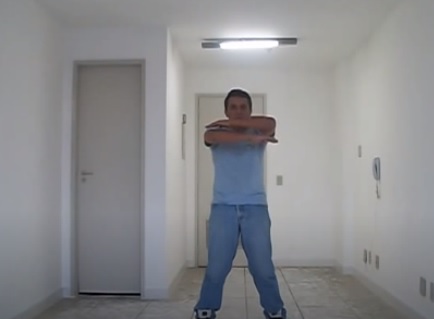
(Na imagem acima, vemos meu Mestre Julio Camacho praticando na antiga sede mundial nos EUA)

(In the image above, we see my Master Julio Camacho practicing 
at the former world headquarters in the USA)

拜 Baai - Siginifica, literalmente, "fazer reverência".
師 Si - É o mesmo "Si" de "Si Fu" ou "Si Hing" . Que pode significar "especialista em algo" ou "Mestre".
Assim, "Baai Si"(拜師) significa "reverenciar o Mestre".
Pode-se dizer que esta é a Cerimônia mais importante da carreira de um praticante, pois ela estabelece a relação vitalícia entre Mestre e Discípulo.
Assim sendo, o praticante que teve o reconhecimento formal, via Cerimônia de Discipulado 
"Baai Si"(拜師), de sua relação familiar vitalícia, com seu Mestre,  tradicionalmente, é chamado de Dai Ji(弟子).

拜 Baai - It literally means "to bow".
師 Si - It is the same "Si" as "Si Fu" or "Si Hing". Which can mean "expert on something" or "Master".
Thus, "Baai Si" (拜師) means "to revere the Master".
It can be said that this is the most important Ceremony of a practitioner's career, as it establishes the lifelong relationship between Master and Disciple.
Therefore, the practitioner who had formal recognition, via Discipleship Ceremony
"Baai Si" (拜師), with his Master, will be considered a Dai Ji (弟子).


Relação Mestre-Discípulo Si-To (師徒):
Master-Disciple Relationship "Si-To"(師徒):


A partir de 1997, meu Mestre Julio Camacho passa a acompanhar seu Mestre Leo Imamura, em suas viagens internacionais. Estes foram, e continuam sendo, momentos importantes do que chamamos de Vida Kung-Fu, pois além de todos os benefícios, Mestre Julio Camacho teve a oportunidade de criar vínculos inclusive com Patriarca Moy Yat, Mestre de seu Mestre.(FOTO)

From 1997, my Master Julio Camacho started to accompany his Master Leo Imamura, on his international trips. These were, and continue to be, important moments of what we call Kung-Fu Life, because in addition to all the benefits, Master Julio Camacho had the opportunity to create bonds even with Patriarch Moy Yat, Master of his Master. (PHOTO)

Este tipo de viagem, além de possibilitou ao meu Mestre ter cada vez mais contato e entrar numa sintonia maior com seu Mestre através de uma convivência de praticamente 24 horas por dia durante anos, fez com que ele também pudesse conhecer vários membros seniors da Moy Yat Ving Tsun, praticantes mais antigos do que seu próprio Mestre, e com eles também desenvolver a Vida Kung Fu. Como vemos nessa foto dele com Grã-Mestre Pete Pajil e sua filha nos anos 90.

This type of trip, in addition to allowing my Master to have more and more contact and to become more in tune with his Master through a coexistence of almost 24 hours a day for years, made him also able to meet several senior members of Moy Yat Ving Tsun, practitioners older than his own Master, and with them also develop Kung Fu Life. As we see in this photo of him with Grandmaster Pete Pajil and his daughter in the 90s.


O Registro Genealógico (juk po 族譜):

O   Registro Genealógico (juk po 族譜) estabelece a história, a identidade e a união de várias gerações de discípulos, desde a Fundadora até seus descendentes presentes.
Ao  seguir os Preceitos de Genealogia do Programa  Moy Yat Ving Tsun de Inteligência Marcial, cada líder de família poderá oferecer uma genealogia de qualidade para seus descendentes.

Para entrar no Registro Genealógico, deve-se ter um nome chinês. Por isso, ao longo do processo discipular, o membro ganha o que chamamos "Nome Kung Fu".

The Genealogical Record (juk po 族譜):

The Genealogical Record (juk po 族譜) establishes the history, identity and union of several generations of disciples, from the Founder to her descendants present.
By following the Genealogy Precepts of the Moy Yat Ving Tsun Program of Martial Intelligence, each family leader will be able to offer a quality genealogy for their descendants.
To enter the Genealogical Register, you must have a Chinese name. That is why, during the discipleship process, the member receives what we call " Kung Fu Name".

A Cerimônia de Discipulado "Baai Si"(拜師) de meu Mestre Julio Camacho ocorreu no antigo Núcleo Central de nossa instituição em São Paulo. Naquele dia, Patriarca Moy Yat(FOTO), exímio inscultor de carimbos chineses(Registros Sigilares), precisava de uma ferramenta para preparar os carimbos dos discipulandos em pedra , e em cima da hora, coube ameu Mestre e seu irmão Kung-Fu , Mestre Marcello Abreu, a tarefa de encontrarem esta ferramenta pelas ruas de São Paulo.

The "Baai Si" (拜師) (Discipleship Ceremony) of my Master took place in the old Central Headquarter of our institution in São Paulo. That day, Patriarch Moy Yat (PHOTO), an excellent artist of Chinese stone seals , needed a tool to prepare the stamps of the disciples in stone, and at the last minute, it was up to my Master and his  Kung -Fu brother Master Marcello Abreu the task of finding this tool through the streets of São Paulo.

Na imagem acima, vemos Mestre Marcello Abreu, Patriarca Moy Yat e meu Mestre Julio Camacho.
Essas camisas que vemos na foto foram dadas, à Mestre Julio e Marcelo Abreu com a moldura em branco em seu centro. E foi o Patriarca quem fez as pinturas de um bambu na camisa de meu mestre, e de um ramo com flores de ameixa na camisa de Mestre Marcelo Abreu. O motivo, segundo Patriarca  Moy Yat: "Vocês são como a flor de ameixa e o bambú: sempre juntos, sempre amigos!"

In the image above, we see Marcelo Abreu, Patriarch Moy Yat and Mestre Julio Camacho.
These shirts we see in the photo were given to my master and Master Marcelo Abreu with the blank frame in their center. And it was Patriarch who made the paintings of a bamboo on their shirt .
O nome-Kung Fu dado a meu Mestre Julio Camacho por Patriarca Moy Yat foi "Moy Jo Lei Ou"(梅祖利奧)

The Kung Fu name given to my Master Julio Camacho by Patriarch Moy Yat was "Moy Jo Lei Ou" (梅祖利奧)


NOME KUNG FU:

O nome Kung-Fu é desenvolvido, muitas vezes, a partir do som do nome da pessoa, encontrando ideogramas similares. Mesmo assim, ideogramas chineses, ainda que diferentes, possuem uma mesma pronúncia. Por isso, os ideogramas devem ser escolhidos com critério, o que vai acabar refletindo uma característica da pessoa e uma advertência (ou ponto a melhorar).

梅祖利奧 Moy Jo Lei Ou significa:

梅(Moy) - É o nome de Família de Moy Yat. Ao dá-lo a um descendente , simbolicamente, é como se Moy Yat adotasse essa pessoa.Sendo Mestre Julio seu discípulo de segunda geração, Moy Yat na condição de descendente legitimo do Ving Tsun, dá esta mesma condição ao discipulo de seu discipulo.

祖(Jo)- signifca "Ancestral".

利(Lei) - pode ser traduzido como "Honrar" (beneficiar,vantagem)

奧(Ou) - significa "mistério" podendo ser estendido a "segredo".

Você pode traduzir de diversas maneiras como:
"O Moy que honra o segredo dos ancestrais."

THE KUNG FU NAME:

The Kung-Fu name is often developed from the sound of the person's name, finding similar ideograms. Even so, Chinese ideograms, although different, have the same pronunciation. Therefore, ideograms must be chosen with discretion, which will end up reflecting a person's characteristic and a warning (or point to improve).

梅祖利奧 Moy Jo Lei Ou means:

梅 (Moy) - It is the family name of Moy Yat. By giving it to a descendant, symbolically, it is as if Moy Yat adopted that person. Being Master Julio his second generation disciple, Moy Yat as the legitimate descendant of Ving Tsun, gives this same condition to his disciple's disciple.

祖 (Jo) - means "Ancestral".
利 (Law) - can be translated as "Honor" (benefit, advantage)
奧 (Or) - means "mystery" and can be extended to "secret".
You can translate in several ways like:

"The Moy who honors the secret of the ancestors."

A fim de honrar seu Mestre,Grão Mestre Leo Imamura preferia que seus alunos/seguidores [ToDai(徒弟)] fizessem a Cerimônia de Discipulado[ "Baai Si"(拜師)] também com Patriarca Moy Yat, e assim, simbolicamente, reforçassem esse vinculo com o Líder da Linhagem .(FOTO)
Na imagem, além de meu Mestre Julio Camacho, vemos em pé, outros dois Grão-Mestres pela International Moy Yat Ving Tsun Federation: Pete Pajil(de casaco) e Miguel Hernandez(segurando a bandeja).
Quando o Mestre bebe o chá oferecido pelo discípulo, está estabelecida uma relação vitalícia entre os dois.

In order to honor his Master, Grandmaster Leo Imamura preferred that his students / followers [ToDai (徒弟)] do the Discipleship Ceremony ["Baai Si" (拜師)] also with Patriarch Moy Yat, and thus, symbolically, reinforce this link with the Lineage Leader. (PHOTO)
In the image, in addition to my Master Julio Camacho, we see two other Grand Masters by the International Moy Yat Ving Tsun Federation: Pete Pajil (wearing Italy Soccer Team coat) and Miguel Hernandez (holding the tray).

When the Master drinks the tea offered by the disciple, a lifelong relationship is established between the two.
Meu Mestre Julio Camacho toca suas pernas, suas duas mãos e sua testa no solo por 3 vezes perante Patriarca Moy Yat, como símbolo máximo de reverência na cultura chinesa, o que mostra a honra de se tornar descendente legitimo daquela pessoa.

My Master Julio Camacho touches his legs, his two hands and his forehead on the ground three times before Patriarch Moy Yat, as a maximum symbol of reverence in Chinese culture, which shows the honor of becoming that person's legitimate descendant.

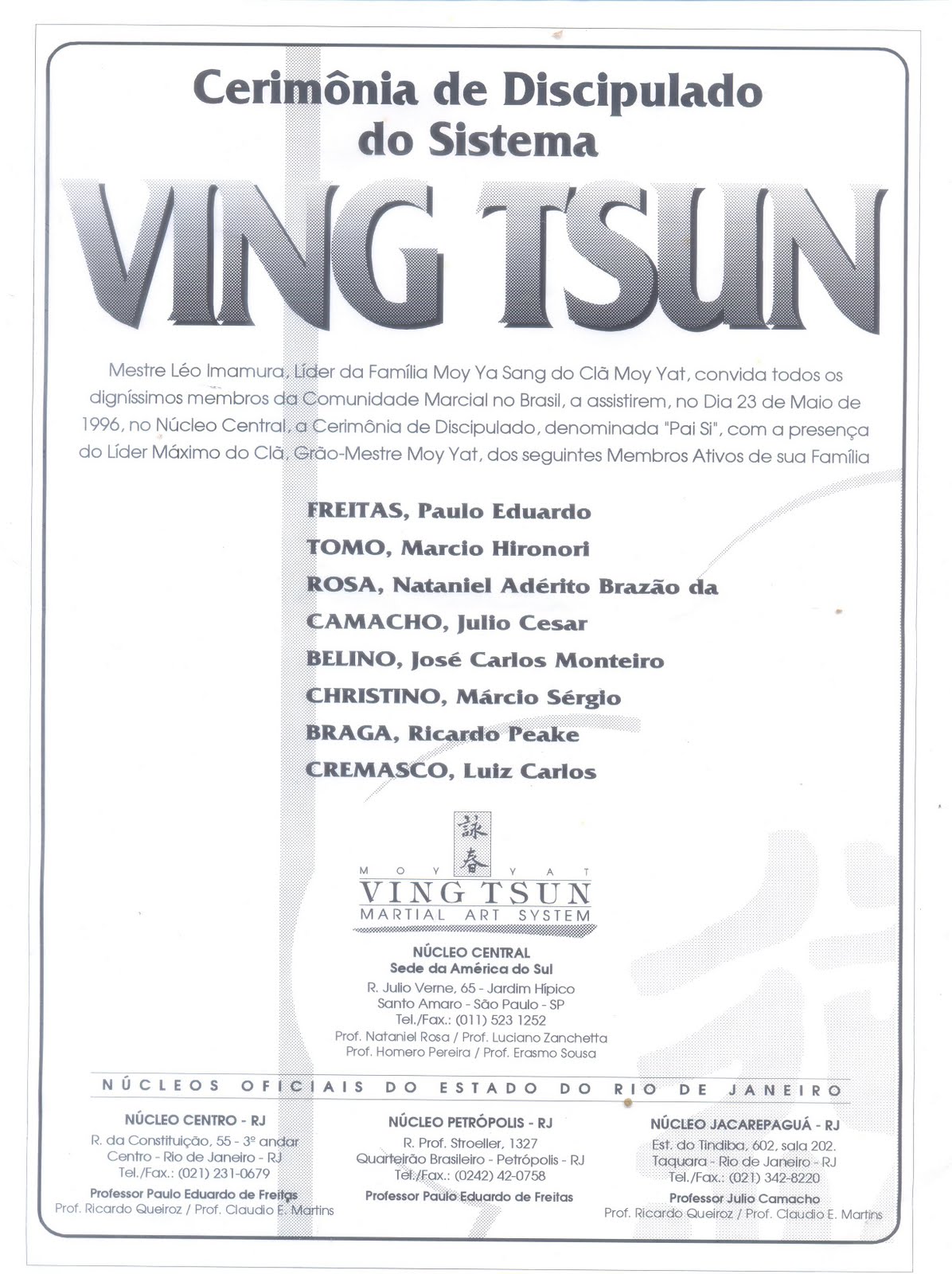
Convite publicado em revista especializada na qual
Grão Mestre Leo Imamura, convida a comunidade marcial do Brasil,
para participar da Cerimônia de Discipulado "Baai Si"(拜師).

Invitation published in a specialized magazine in which
Grandmaster Leo Imamura, invites the martial community of Brazil,
to participate in the "Baai Si" Discipleship Ceremony (拜師).
Meu Mestre Julio Camacho, nos anos seguintes, continuou honrando seu compromisso estabelecido com seu Mestre, o acompanhando em suas viagens internacionais (vemos na foto os dois ao lado do renomado Grão- Mestre  ,o lendário Sr. Micky Chan). Mas principalmente,meu Mestre sempre fala em estar em sintonia com seu Mestre, ainda que ambos morem em países diferentes.

My Master Julio Camacho, in the following years, continued to honor his commitment established with his Master, accompanying him on his international trips (we see in the photo the two together with the renowned Grand Master, the legendary Mr. Micky Chan). But mainly, my Master always talks about being in tune with his Master, even though both live in different countries.
 Meu Mestre, nas quase 20 viagens que fez a NY sempre fica hospedado na casa de
Grão-Mestre Miguel Hernandez. Na foto acima, vemos os dois praticando Chi Sau na loja esportiva deste último.

My Master, in the almost 20 trips he made to NY he always stays at Grand Master Miguel Hernandez's place. In the picture above, we see the two practicing Chi Sau in the latter's sports shop.
Meu Mestre (a esquerda na foto) investiu muito de seu tempo na Vida Kung-Fu com Grão-Mestre Leo Imamura, e graças a isso, participou de momentos que mais tarde se tornariam lendários dentro do Clã, como a famosa visita a esta escola de outra arte marcial no Kentucky,EUA.

My Master (left in the photo) invested a lot of his time in Kung-Fu Life with Grand Master Leo Imamura, and thanks to that, he participated in moments that would later become legendary within the Clan, such as the famous visit to this school of another martial art in Kentucky, USA.
Recebeu inúmeras lembranças, muitas delas feitas pelas próprias mãos de Patriarca Moy Yat.

He received numerous memorabilia, many of them made by Patriarch Moy Yat himself.
1998,Rio de Janeiro:
O quadro de patriarca Ip Man no boneco de madeira.

1998, Rio de Janeiro:
Patriarch Ip Man's picture on the wooden dummy.

Meu Mestre Julio Camacho auxilia seu Mestre durante demonstração nos anos 90.

My Master Julio Camacho assists his Master during a demonstration in the 90s.

Praticando nos EUA.

Practice in US.
Acompanhando seu Mestre Leo Imamura em treino noturno com Grão-Mestre Pete Pajil.

Accompanying his Master Leo Imamura in night training with Grand Master Pete Pajil.
Trabalhando na antiga sede mundial da MYVT nos Estados Unidos.

Working at MYVT's former world headquarters in the United States.

Com relação ao Discipulado["Baai Si"(拜師)], a manutenção e reforço deste vinculo vai, naturalmente com o decorrer do tempo, colocá-los em diferentes níveis dentro desta relação, ou ainda que não seja este o caso, os discípulos são categorizados de acordo com sua origem ou natureza:

With regard to Discipleship ["Baai Si" (拜師)], the maintenance and strengthening of this link will, naturally over time, place them at different levels within this relationship, or even if this is not the case, the disciples are categorized according to their origin or nature:

"Discípulo de Portas Abertas"(Hoi Mun Dai Ji)

"Hoi Mun Dai Ji" é o "discípulo de portas abertas". Por "portas" leia "Família" ou leia "Portas" como o objeto em si, mas nesse caso "portas abertas para discípulos".
Isso quer dizer que enquanto o Mestre não se aposenta de suas atividades, "as portas de sua 
Família Kung Fu estão abertas".

"Open Door Disciple" (Hoi Mun Dai Ji)

"Hoi Mun Dai Ji" is the "disciple with open doors". For "doors" read "Family" or read "Doors" as the object itself, but in this case "open doors for disciples".
This means that while the Master does not retire from his activities, "the doors of his
Kung Fu family are open ".

"Discípulo de Portas Fechadas"(Gwaan Mun Dai Ji)

Quando o Mestre se aposenta, ele não aceita mais discípulos. Portanto, as "portas se fecham". Porém, ocorrem exceções, e a mais famosa delas foi justamente Ip Man.
Ip Man começou seu Kung Fu quando seu Mestre Chan Wah Shun já estava aposentado. Por isso, Ip Man é um "Discípulo de Portas Fechadas"

"Closed Door Disciple" (Gwaan Mun Dai Ji)

When the Master retires, he no longer accepts disciples. Therefore, the "doors close". However, there are exceptions, the most famous of which was Ip Man.
Ip Man started his Kung Fu when his Master Chan Wah Shun was already retired. For this reason, Ip Man is a "Closed Door Disciple"

"Discípulo que entra na sala"(Yap Sat Dai Ji)

Um discípulo que tem muita proximidade com o Mestre está livre para entrar em recintos do local de treino (Mo Gun) ou da própria casa do Mestre, o que um discípulo comum não poderia.

"Disciple entering the room" (Yap Sat Dai Ji)

A disciple who is very close to the Master is free to enter the training area (Mo Gun) or the Master's own house, which an ordinary disciple could not.
Interessante dizer que, mesmo após se tornar um Mestre Classe Senior,meu Mestre continua honrando seu compromisso estabelecido em 1996 com seu Mestre, o Sr. Leo Imamura.
Ainda que os conteúdos do sistema tenham sido todos recebidos por ele, meu mestre acredita que apenas o convívio e a sintonia com seu Mestre. Cada vez mais farão dele um praticamente melhor, bem como, um homem melhor.

It is interesting to say that, even after becoming a  Senior Master, my Master continues to honor his commitment established in 1996 with his Master, Mr. Leo Imamura.
Even though the contents of the system have all been received by him, my master believes that it is only coexistence and attunement with his Master. More and more will make him better practitioner, as well as, a better man.


THE DISCIPLE OF MASTER JULIO CAMACHO
Thiago Pereira "Moy Fat Lei"
moyfatlei.myvT@gmail.com

sábado, 16 de maio de 2020

眼法 (NGAN FAAT) - SI FU´S SECRET ON HOW TO USE SIU NIM TAU WHEN SOMEONE IS BREAKING DOWN

(Si Fu faz "Siu Nim Tau" no dia em que pegou as chaves
 da nova sala na Barra da Tijuca, Zona Oeste do Rio em 2004)

(Si Fu does the "Siu Nim Tau" on the day he took the keys
of the new room in Barra da Tijuca, West Zone of Rio in 2004)

Quando comecei a praticar o Ving Tsun, muito se dizia sobre a palavra "focar" relacionada ao Siu Nim Tau. Foram necessários doze anos para que eu pudesse resignificar esse entendimento, pois dizia-se naquele momento, que quando expandíamos os braços lateralmente na  altura dos ombros na segunda parte do Siu Nim Tau, deveríamos utilizar-nos da chamada "visão periférica".
Sem refletir sobre o tema com afinco, doze anos depois ao acompanhar meu Si Fu numa prática da minha irmã Kung Fu mais nova Cynthia Tong, ouvi de Si Fu que ela poderia "relaxar o olhar".
Si Fu teria dito que ao focarmos, tendemos a desconsideramos tudo que está à nossa volta. Segundo ele isso também acontecia com a "chamada visão periférica". Portanto, dizia Si Fu que ao relaxarmos o olhar, podemos perceber "o todo". Aquela fala me trouxe uma nova consciência sobre as informações que recebera doze anos antes, e que não me dediquei a amadurecer.

When I started practicing Ving Tsun, a lot was said about the word "focus" related to Siu Nim Tau. It took twelve years for me to reshape that understanding. For it was said at that time, that when we expanded our arms laterally at shoulder height in the second part of Siu Nim Tau, we should use the so-called "peripheral vision".
Without thinking hard about the theme, twelve years later, following my Si Fu teaching my younger Kung Fu sister Cynthia Tong, I heard from Si Fu that she could "relax her eyes".
Si Fu would have said that when we focus, we tend to disregard everything around us. According to him, this also happened with the so called "peripheral vision". Therefore, Si Fu said that when we relax our eyes, we can perceive "the whole". That speech brought me a new awareness of the information I had received twelve years earlier, and which I did not dedicate myself to maturing.

Quando falamos em "Faat"(法) em artes marciais chinesas, podemos estar nos referindo à inúmeras possibilidades. Podemos por exemplo estar nos referindo à "Sau Faat"(手法) que em um caso, podemos falar do "uso das mãos" em determinado estilo, Sistema ou momento de um Sistema de Variação. Porém, ainda que não muito evidenciado, algumas artes marciais fazem uso de um "法"(Faat) para os "Olhos"(眼 Ngan) o que chamaríamos de "Ngan Faat"(眼法).

When we speak of "Faat" (法) in Chinese martial arts, we may be referring to a myriad of possibilities. We may, for example, be referring to "Sau Faat" (手法) that in one case, we can speak of "the use of hands" in a certain style, System or moment of a System of Variation. However, although not very evident, some martial arts use an "Faat"(法) for" Eyes "(眼 Ngan) what we would call" Ngan Faat "(眼 法).
(Aqui eu faço "Siu Nim Tau" no dia em que peguei as chaves
 da nova sala na Méier, Zona Norte do Rio em 2011)

(Here I was doing the "Siu Nim Tau" on the day I took the keys
of the new room in Meier "Wild" Neighborhood, North Zone of Rio in 2011)


Quando tomamos como exemplo este trecho da segunda parte do Siu Nim Tau. Muitas pessoas preparam o movimento, e por só enxergar o momento do preparo e do ponto final da execução. Não estão conscientes do percurso dos braços ao longo dos 180º, e muito menos dos olhos.
Ademais o ideograma "Nim"(念) de "Siu Nim Tau", une dois ideogramas: O "Gam"(今) que se refere à um processo de algo "atual". E o "Sam"(心), que pode ser entendido por "consciência". Desta forma, conforme ouvi quando comecei nesta trajetória do Sistema Ving Tsun. O "Nim"(念) de "Siu Nim Tau" se refere à um processo de "atualizar a consciência", ou seja: De manter-se presente durante toda a trajetória do movimento, e não apenas quando ele começa ou quando ele termina.

When we take as an example this part of the second part of Siu Nim Tau. Many people prepare the movement, and just see the moment of preparation and the end point of the execution. They are not aware of the trajetory of the arms over 180 degrees, and also they are not aware of the eyes during this process.
In addition the ideogram "Nim" (念) of "Siu Nim Tau", unites two ideograms: "Gam" (今) that refers to a process of something "actual". And "Sam" (心), which can be understood as "conscience". In this way, as I heard when I started on this path of the Ving Tsun System. The "Nim" (念) of "Siu Nim Tau" refers to a process of "updating consciousness", that is: of being present during the entire trajectory of the movement, and not just when it starts or when it ends .
Portanto, quando expandimos nossos braços lateralmente, precisamos considerar também todas as possibilidades ao longo dessa expansão de 180º, e não apenas seu preparo e o final da execução. E mais: Como nos manter conscientes durante o movimento? Talvez seja o caso de executar os "Jiu Sik" em um timing de encadeamento que nos seja possível estar presente mentalmente.

Therefore, when we expand our arms laterally, we also need to consider all the possibilities throughout this 180º expansion, and not just its preparation and the end of the execution. And more: How to keep us conscious during the movement? Perhaps it is the case of executing the "Jiu Sik" in a timing chain that is possible for us to be present mentally.
Portanto, em um momento como esse que estamos vivendo, onde pessoas conseguem apenas se perceber como "saudáveis" ou "entubadas" numa UTI. Ou "Prósperas"ou "falidas". Nós poderíamos relaxar o nosso olhar, como sugeriu Si Fu à minha irmã Kung Fu. Para que assim como na expansão lateral dos braços da segunda parte do Siu Nim Tau. Possamos apreciar todas as possibilidades que se abrem para nós. E não apenas seus extremos. Não sejamos míopes, usemos Kung Fu com nossos olhos.

Therefore, at a time like the one we are living in, where people can only perceive themselves as "healthy" or "intubated" in an ICU. Or "Prosperous" and "bankrupt". We could relax our eyes, as Si Fu suggested to my Kung Fu sister . So that as in the lateral expansion of the arms of the second part of Siu Nim Tau. We can appreciate all the possibilities that are open to us. And not just its extremes. Let us not be shortsighted, let us use Kung Fu with our eyes.


The Disciple of Master Julio Camacho
Thiago Pereira "Moy Fat Lei"
moyfatlei.myvt@gmail.com

domingo, 10 de maio de 2020

PATRIARCH MOY YAT ON MOTHER´S DAY (FROM "A LEGEND OF KUNG FU MASTERS)

No "Dia das mães", trazemos mais uma vez doze anos depois, o artigo de Si Taai Gung Moy Yat sobre esta data. O artigo "Mother´s day" está presente em seu livro "A Legend of Kung Fu Masters". 

On "Mother's Day", we bring you again twelve years later, Si Taai Gung Moy Yat's article on this date. The article "Mother´s day" is present in his book "A Legend of Kung Fu Masters".
(SCROLL DOWN FOR ENGLISH VERSION)


"MOTHER´S DAY" (Texto do Livro "A Legend of Kung Fu Masters")

Mudei-me para os Estados Unidos dezessete anos atrás. Antes disso, eu nunca tinha visto o "Dia das Mães", embora agora eu o veja todos os anos. É estranho que um dia tão importante não seja comemorado na China. Até escrever um artigo sobre o dia das mães, nunca percebi que tinha tão pouco conhecimento sobre um evento tão importante.
Como se originou o dia das mães? Por que o dia das mães é um feriado separado? Como alguém de fora, acho difícil entender a ideia do dia das mães. Talvez se eu fosse mulher fosse mais fácil. Eu gostaria de descrever meus sentimentos sobre minha mãe e este dia das mães. Tentei escrever um poema, mas não tinha as palavras. Então eu farei o meu melhor.
Praticamente todo ser vivo tem uma mãe. Os seres humanos são criaturas peculiares, nascidas com uma espécie de grosseria. Nós respeitamos e admiramos coisas que são raras e incomuns. As mães são tão comuns (todo mundo tem uma), por isso não prestamos atenção especial a elas, apenas dando-as como garantidas.
Embora eu faça meu próprio horário, geralmente estou muito ocupado. Eu tenho pouco tempo para a TV. Ultimamente, no entanto, eu vi um programa de Hong Kong chamado "Mãe". A história foi tão emocionante que eu chorei. A mãe da história foi tão gentil que me lembrou muito minha mãe e minhas mães em todos os lugares.
O dia das mães em Chinatown é muito movimentado, principalmente nos restaurantes. Grandes grupos de família cercam a mãe rindo colocando flores em suas mãos, todos jantando juntos. Pelo menos eles a alimentam uma vez por ano, então a mãe está muito feliz neste dia.
Bebês jovens são alimentados por suas mães. O leite da mãe flui para a boca do bebê desde o primeiro dia de vida e continua por muitas e muitas refeições, aqui e em todo o mundo. Em quase qualquer dia, você pode ir a qualquer lugar e ver as mães alimentando seus filhos, não apenas no dia das mães. Eu próprio tenho mãe, mas nunca notei o dia das mães. Faço refeições em casa com minha mãe todos os dias, e minha mãe diz que é mais feliz do que outras mães que só comem fora com suas famílias uma vez por ano.
Um dia desses, se eu tiver o poder de conquistar o mundo inteiro, a primeira coisa que farei é mudar o dia 13 de maio para 365 dias do dia das mães.


"Mother´s Day" (Text from the book "A Legend of the Kung Fu Masters")

I moved to the United States seventeen years ago. Before that time I never saw a "Mother´s Day", although now I see it every year. It´s strange that such a big day is not celebrated in China. Until I had to write an article about Mother´s day I never realized I had such little knowledge about such an important event.

How did Mother´s Day originate? Why is Mother´s Day a separate holiday? As an outsider I find it difficult to understand the idea of a Mother´s Day. Perhaps if I were a woman it would be easier. I would like to describe my feelings about my mother and this Mother´s Day. I tried to write a poem, but didn´t have the words. So I´ll do my best. 

Virtually every living thing has a mother. Human beings are peculiar creatures, born with a kind of rudeness. We respect and admire thing that are rare and uncommon. Mothers are so common(everybody had one), so we pay them so special attention, just taking them for granted. 

Even though I make my own schedule I´m usually very busy. I have little time for TV. Lately, however, I saw a program from Hong Kong called "Mother". The story was so touching that I cried. The mother in the story was  so kind, she reminded me very much of my own mother and mothers everywhere.

Mother´s Day in Chinatown is very busy, especially in the restaurants. Large groups of family surround the laughing lady with flowers on her chest, all having dinner together. At least they feed her once a year, so mother is very happy on this day. 


Young babies are fed by their mothers. Mother´s milk flows to the baby´s mouth from his first day of life, and continues for many, many meals, here and all over the world. On almost any day you can go anywhere and asee the mothers feeding their children, not just on Mother´s Day. I myself have a mother, but I never noticed a Mother´s Day. I have meals home with my mother everyday, and my mother says she´s happier than other mothers who only eat out with their families once a year.

One of these days, if I have the power to conquer the whole world, the first thing I´ll do is to change May 13th Mother´s Day into 365 days of Mother´s day.

sexta-feira, 8 de maio de 2020

3 TIMES I ALMOST GIVE UP THE VING TSUN PRACTICE

Durante a trajetória de um praticante de Ving Tsun, podem não ser poucas as oportunidades em que ele pensa em interromper sua jornada. De fato, um dos grandes pontos para seguir firme em determinado processo sem desistir, diz respeito ao meu ver, a ter claros os seus valores pessoais. Sobre valores pessoais, na primeira palestra que participei de Si Gung, perguntei a ele porque a Moy Yat Ving Tsun não promovia trabalhos com pessoas carentes. Ele me perguntou meu nome e depois perguntou o que eu entendia por "carência". Dei o exemplo de estar andando na rua com um casaco de moletom e ao ver um morador de rua sentindo frio dar meu casaco. Si Gung sorriu e perguntou--me: "Então você está me dizendo, que se um morador de rua estivesse com frio você daria seu casaco?" - Respondi que "sim" e ele complementou com outra pergunta - "Mas e se ele dissesse que só sente frio nas pernas? Você daria suas calças?"
Este foi o primeiro contato mais próximo com Si Gung fora de uma Cerimônia e percebi, mesmo aos quinze anos de idade, que com uma simples mudança de cenário, meus valores pessoais não se sustentavam. Ou seja: Eu não era capaz de defender o que era importante para mim.

During the journey of a Ving Tsun practitioner, there may be many opportunities when he thinks about interrupting his journey. In fact, one of the great points for staying firm in a given process without giving up, is in my view, having your personal values ​​clear. On personal values, in the first lecture I attended Si Gung, I asked him why Moy Yat Ving Tsun did not promote work with people in need. He asked me my name and then asked what I meant by "neediness". I gave the example of walking on the street in a coat and seeing a homeless man feeling cold and I would give him my coat. Si Gung smiled and asked me: "So you are telling me, that if a homeless person were cold you would give him your coat?" - I answered "yes" and he added with another question - "But what if he says that he only feels cold in his legs? Would you give your pants?"
This was the first closest contact with Si Gung outside of a Ceremony and I realized, even at the age of fifteen years old, that with a simple change of scenery, my personal values ​​could not be sustained. In other words: I was not able to defend what was important to me.
(Com meu Si Hing Cledimilson)
(With my Si Hing Cledimilson)

Foi em 2001 a primeira vez que eu quase parei de praticar o Ving Tsun. Já estava na metade do Domínio Cham Kiu, e não conseguia me perceber me tornando o "lutador" que almejava ser. A prática de "Chi Sau" não me dizia nada e foram muitas as vezes que eu chegava com minha bicicleta preta na porta do Mo Gun da Avenida Nelson Cardoso na Taquara, parava na porta, desistia e voltava para casa. Repeti esse processo por dois meses, até que minha mãe disse que não pagaria para eu não ir. Si Fu nos chamou no Mo Gun, conversou com minha mãe, e a pergunta final cabia a mim responder. Disse ele: "Você ainda quer praticar?" - Respondi que sim.
A partir dali, minhas sessões passaram a ser com meu Si Hing Cledimilson(foto). Lembro-me dele pedindo que eu o golpeasse com força: "Só isso, rapaz? Pode soltar". - As práticas passaram a ser divertidas, e eu comecei a ver, a minha própria maneira, a relevância do Chi Sau.

It was the first time in 2001 that I almost stopped practicing Ving Tsun. I was already in the middle of the Cham Kiu Domain, and I could not see myself becoming the "fighter" I wanted to be. The practice of "Chi Sau" said nothing to me and many times I arrived with my black bicycle at the door of the Mo Gun on  Nelson Cardoso Avenue in Taquara neighborhood(West Zone of Rio),I would stop at the front door of the Mo Gun, gave up and returned home. I repeated this process for two months, until my mother said she would not pay the fees for me not to go. Si Fu called us at Mo Gun, talked to my mother, and the final question was up to me to answer. He said, "Do you still want to practice?" - I said "yes".
From then on, my private sessions started to be with my Si Hing Cledimilson (photo). I remember him asking me to hit him harder: "Is that all, boy? You can let go. Punch harder!". - The practices became fun, and I started to see, in my own way, the relevance of Chi Sau.
(Com os Si Suk Andre e Ursula)
(With the Si Suk Andre and Ursula)

Mais tarde no Domínio "Biu Ji", passei a ter sessões com o Si Suk André e Si Suk Ursula. Ao longo dos meses e dos anos, estas duas pessoas de diferentes maneiras. Foram muito importantes para minha trajetória e para que eu pudesse me sentir parte do grupo.

Later in the Domain "Biu Ji", I started to have sessions with Si Suk André and Si Suk Ursula. Over the months and years, these two people in different ways. They were very important for my journey and for me to feel part of the group.

Em 2007, formalizei meu ingresso da Família Moy Yat Sang para a Família Moy Jo Lei Ou(FOTO). Devido ao meu convívio com meu Si Fu, para mim fazia mais sentido ser um membro de sua Família. Dois meses depois, realizava o Baai Si. Mas isso tudo só aconteceu, pois em Janeiro daquele ano, ao viajar sozinho com Si Fu para três dias de seminário em São Paulo, mesmo tendo me dedicado técnicamente desde 1999 e a Vida Kung Fu de forma mais intensa nos últimos dois anos. Levei a pior numa prática de Maai San Jong com um praticante de Minas Gerais. Nas duas tentativas de passar da distância longa para a média e golpeá-lo, antes de pisar no chão ele me derrubou com um dos seus pés. Duas vezes seguidas, a mesma coisa.
Levantei os olhos, vi algumas pessoas olhando e pensei: "É isso... Não dá pra mim...". - Na Terça depois que chegamos ao Rio, pedi para conversar com Si Fu e comunicar meu afastamento. Ele lamentou dizendo algumas palavras, nos abraçamos e eu sai pela porta. Dois dias depois estava de volta, algo havia mudado. Eu não conseguia mais ir embora.

In 2007, I formalized my entry from the Moy Yat Sang Family to the Moy Jo Lei Ou Family (PHOTO). Due to my relationship with my Si Fu, it made more sense to me to be a member of his Family. Two months later, I was doing Baai Si. But it all just happened, because in January of that year, when traveling alone with Si Fu for three days of seminar in São Paulo, even though I dedicated myself technically since 1999 and more intensily to Kung Fu Life  in the past two years. I took the worst in a Maai San Jong practice with a practitioner from Minas Gerais State. In both attempts to move from long to medium distance and hit him, before I stepped on the ground he knocked me over with one of his feet. Twice in a row, the same thing.
I looked up, saw some people looking and thought: "That's it ... I can't do it anymore ...". - On the Tuesday after we arrived in Rio, I asked to talk to Si Fu and report my departure : I was leaving the Family. He regretted saying a few words, we hugged and I walked out the door. Two days later I was back, something had changed. I could not walk away.
(Com Si Fu e meus Si Hing Cledimilson e Leonardo)
(With Si Fu and the Si Hing Cledimilson and Leonardo)

Cada um de nós, possui a cada momento da vida, fatores limitantes que nos impedem de seguir adiante. Em nosso íntimo, acreditamos verdadeiramente que aquilo só está acontecendo conosco. É como se fizéssemos uma pessoalização de um problema que atingiu vários praticantes ao longo das gerações e que conseguiram superá-lo. Mas acreditamos que na nossa vez é especial...É diferente... Por isso, vamos embora.
No meu caso, havia apenas uma miopia em relação ao que eu estava fazendo, meu objetivo de virar um lutador e o que de fato eu era capaz de fazer. Quando tudo isso se alinhou dentro de mim, pude descobrir minha vocação. Por isso, a ajuda do Si Fu e dessas pessoas que aqui citei, foram fundamentais para que de "último da fila" se alguém tivesse que apostar em quem se tornaria Mestre.  Eu pudesse chegar nesse ponto.
Mas no final das contas, a pergunta que Si Fu me fez em seu escritório com a presença da minha mãe, tenha sido decisiva para meu processo não só como praticante, mas como Mestre também: "Você ainda quer praticar?" - Se você conseguir responder que "Sim", todo o resto passam a ser desculpas para adiar a dor de desfazer-se de camadas que lhe impedem de se desenvolver como ser humano. Assim, a "Honestidade" é o último nível de um artista marcial. A honestidade consigo mesmo.

Each of us, at each moment of life, has limiting factors that prevent us from moving forward. Inwardly, we truly believe that this is only happening to us. It is as if we made a personalization of a problem that has reached several practitioners over the generations and that have managed to overcome it. But we believe that our turn is special ... It's different ... So, lets go away.
In my case, there was only a short-sightedness about what I was doing, my goal of becoming a fighter and what I was actually able to do. When all this was aligned within me, I was able to discover my vocation. For this reason, the help of Si Fu and these people I mentioned here, were fundamental for the "last in line" if someone had to bet on who would become a Master. I could get to that point I´m in today.
But in the end, the question that Si Fu asked me in his office with the presence of my mother, was decisive for my process not only as a practitioner, but as a Master as well: "Do you still want to practice?" - If you can answer "Yes", everything else becomes an excuse to postpone the pain of getting rid of layers that prevent you from developing yourself as a human being. Thus, "Honesty" is the ultimate level of a martial artist. Honesty with yourself.


The Disciple of Master Julio Camacho
Thiago Pereira "Moy Fat Lei"
moyfatlei.myvt@gmail.com
@thiago_moy


quinta-feira, 7 de maio de 2020

THE GREATEST ACTION MOVIE OF ALL TIME IS CHINESE

By 
Thiago Pereira


Muitos consideram “Exterminador do Futuro 2” (Terminator 2, 1991) o maior filme de ação de
todos os tempos. Porém, pouca gente conhece “Police Story”( 警察故事系列,1985)
estrelado, dirigido e produzido por Jackie Chan. Um filme tão incrível que rendeu cinco filmes
posteriores e é considerado o filme mais copiado de todos os tempos.

Many consider "Terminator 2" (1991) the greatest action movie of all time. However, few people know "Police Story" (警察 故事 系列, 1985) starring, directed and produced by Jackie Chan. A film so incredible that it yielded five later films and is considered the most copied film of all time.
(Jackie Chan em cena de "O Protetor", 1985)
(Jackie Chan on the scene of "The Protector", 1985)

“Police Story” surgiu após o fracasso do obscuro filme “O Protetor”(The Protector, 1985),
dirigido por James Glickenhaus com quem Jackie Chan teve sérios problemas durante a
produção. Ao ponto de existir uma versão americana(editada por James Glickenhaus) e uma
versão chinesa(editada por Jackie Chan).
Um dos grande problemas de “O Protetor”, era com uma série de restrições criativas e
principalmente para com as performances acrobáticas de Jackie Chan e sua equipe, pois as
empresas de seguro não queriam cobrir os riscos.
Após o grande fracasso seguido da frustração de saber que poderia ter feito um trabalho
muito melhor, Jackie Chan retorna para Hong Kong e promete fazer o maior filme de ação de
todos os tempos. O que de fato conseguiu.

“Police Story” came about after the failure of the obscure film “The Protector” (1985), directed by James Glickenhaus with whom Jackie Chan had serious problems during production. To the point that there is an American version (edited by James Glickenhaus) and a Chinese version (edited by Jackie Chan).
One of the big problems of "The Protector" was with a series of creative restrictions and mainly with the acrobatic performances of Jackie Chan and his team, because the insurance companies did not want to cover the risks.
After the big failure followed by the frustration of knowing he could have done a much better job, Jackie Chan returns to Hong Kong and promises to make the greatest action movie of all time. What you actually achieved.

Em "Police Story", Jackie interpreta Chan Ka Kui (ou Kevin Chan na versão americana). Um policial
incorruptível, que participa de uma operação chamada “Caçada ao Javali” na qual a Polícia Real
de Hong Kong pretende prender o chefão do crime organizado Chu Tao (interpretado pelo ator
Chor Yuen).
Toda a sequência inicial na qual Jackie Chan persegue os criminosos ladeira abaixo numa favela
dentro de carros destruindo barracos e explodindo botijões de gás seguida por sua
perseguição à pé atrás de um ônibus onde está o criminoso. Fora copiadas respectivamente
nos filmes “Bad Boys II”(2003) e “Tango e Cash”(1989).

In "Police Story", Jackie plays Chan Ka Kui (or Kevin Chan in the American version). An incorruptible police officer, who is taking part in an operation called “Boar Hunt” in which the Royal Hong Kong Police intend to arrest organized crime boss Chu Tao (played by actor Chor Yuen).
The entire initial sequence in which Jackie Chan chases criminals down the slope in a slum in cars destroying shacks and blowing up gas canisters followed by his chase on foot behind a bus where the criminal is. They were copied respectively in the films “Bad Boys II” (2003) and “Tango and Cash” (1989).

O personagem de Jackie Chan (Chan Ka Kui ou Kevin Chan) após prender o chefão, precisa
proteger a secretária dele interpretada pela belíssima Brigitte Lin (foto à direita). O problema é
que Selina Fong (Brigitte Lin) não gosta de ser obrigada a ficar sob a proteção de Jackie Chan, e
assim começa a sabotar toda a operação na noite que antecede o julgamento.
Para completar, ela faz com que a namorada de Jackie Chan no filme,interpretada por uma das
atrizes mais lindas da história do cinema de Hong Kong Maggie Cheung(a esquerda). Ache que ele a estátraindo.

The character of Jackie Chan (Chan Ka Kui or Kevin Chan) after arresting the big boss, needs to protect his secretary played by the beautiful Brigitte Lin (photo on the right). The problem is that Selina Fong (Brigitte Lin) does not like being forced to be under the protection of Jackie Chan, and thus begins to sabotage the entire operation the night before the trial.
To top it off, she makes Jackie Chan's girlfriend in the film, played by one of the most beautiful actresses in Hong Kong film history Maggie Cheung (left on the photo above). Think he's cheating on her.

Apesar do tom sério do filme, as cenas de comédia são simplesmente épicas. May (Maggie
Cheung) é o alívio cômico da produção. Pois o personagem de Jackie Chan é tão dedicado ao
trabalho, que sempre acaba fazendo alguma trapalhada com sua namorada. As cenas entre os
dois “terminando” e “reatando” o relacionamento são simplesmente hilárias!

Despite the serious tone of the film, the comedy scenes are simply epic. May (Maggie Cheung) is the comic relief of the production. Because the character of Jackie Chan is so dedicated to work, that he always ends up doing some mess with his girlfriend. The scenes between the two "breaking up" and "resuming" the relationship are just hilarious!


Outro ator veterano que aparece ao lado de Jackie Chan na cena acima, é Bill Tung(no fundo conversando com jackie). Em todos os filmes de Jackie Chan nos quais ele participa. Seus personagens sempre se chamam “Tio Bill”. Ele sempre aparece como uma espécie de “voz da razão” para os personagens de Jackie Chan.

Another veteran actor who appears alongside Jackie Chan in the scene above is Bill Tung (in the background talking to Jackie). In all of Jackie Chan's films in which he participates. His characters are always called "Uncle Bill". He always appears as a kind of "voice of reason" for the characters of Jackie Chan.

Police Story(1985) é um filme imperdível no qual Jackie Chan se entrega de corpo e alma à
produção (por vezes arriscando a própria vida). Levando a si mesmo e toda a sua equipe de
dublês ao limite, criando um novo paradigma para o cinema policial de Hong Kong.
Ao ser exibido no Festival de Cannes, o filme foi aplaudido em várias cenas, como na que ele
fica pendurado num ônibus de dois andares apenas por um guarda-chuvas e ao final foi
aplaudido de pé.

Police Story (1985) is an unmissable film in which Jackie Chan surrenders body and soul to the production (sometimes risking his own life). Taking himself and his entire stunt team to the limit, creating a new paradigm for Hong Kong police cinema.
When shown at the Festival de Cannes, the film was applauded in several scenes, such as the one that hangs on a double-decker bus only by an umbrella and at the end it was applauded standing up.

Além disso, a produção ganhou os seguintes prêmios em 1986(ano seguinte a sua estréia):

  • Melhor filme
  • Melhor coreografia de ação
  • Melhor diretor: Jackie Chan
  • Melhor ator: Jackie Chan
  • Melhor atriz: Bigitte Lin
  • Melhor fotografia: Cheung Yin Cho
In addition, the production won the following awards in 1986 (the year following its debut):

Best movie
Best action choreography
Best Director: Jackie Chan
Best actor: Jackie Chan
Best actress: Bigitte Lin
Best Photography: Cheung Yin Cho

Cena de "Police Story"(1985) em comparação ao filmes "Bad Boys 2"(2003). 
Toda a sequência é similar.

Scene from "Police Story" (1985) compared to the films "Bad Boys 2" (2003). 
The whole sequence is similar.

Cena de "Police Story"(1985) em comparação à "Tango & Cash"(1989) . 
Toda a sequência é idêntica nos dois filmes.

Scene from "Police Story" (1985) compared to "Tango & Cash" (1989).
 The entire sequence is identical in both films.