Mostrando postagens com marcador yip. Mostrar todas as postagens

domingo, 24 de maio de 2020

MASTER JULIO CAMACHO´S "BAAI SI": Kung Fu Name, Types of Disciples, Kung Fu Life and more!


Nessa semana comemoramos uma data muito importante, os 24 anos da Cerimônia de Discipulado  de meu Mestre Julio Camacho, um dos membros mais importantes da Moy Yat Ving Tsun Martial Intelligence na América Latina.

This week we celebrated a very important date, the 24th anniversary of the Discipleship Ceremony of my Master Julio Camacho, one of the most important members of Moy Yat Ving Tsun Martial Intelligence in Latin America.


(Na imagem acima, vemos meu Mestre Julio Camacho praticando na antiga sede mundial nos EUA)

(In the image above, we see my Master Julio Camacho practicing 
at the former world headquarters in the USA)

拜 Baai - Siginifica, literalmente, "fazer reverência".
師 Si - É o mesmo "Si" de "Si Fu" ou "Si Hing" . Que pode significar "especialista em algo" ou "Mestre".
Assim, "Baai Si"(拜師) significa "reverenciar o Mestre".
Pode-se dizer que esta é a Cerimônia mais importante da carreira de um praticante, pois ela estabelece a relação vitalícia entre Mestre e Discípulo.
Assim sendo, o praticante que teve o reconhecimento formal, via Cerimônia de Discipulado 
"Baai Si"(拜師), de sua relação familiar vitalícia, com seu Mestre,  tradicionalmente, é chamado de Dai Ji(弟子).

拜 Baai - It literally means "to bow".
師 Si - It is the same "Si" as "Si Fu" or "Si Hing". Which can mean "expert on something" or "Master".
Thus, "Baai Si" (拜師) means "to revere the Master".
It can be said that this is the most important Ceremony of a practitioner's career, as it establishes the lifelong relationship between Master and Disciple.
Therefore, the practitioner who had formal recognition, via Discipleship Ceremony
"Baai Si" (拜師), with his Master, will be considered a Dai Ji (弟子).


Relação Mestre-Discípulo Si-To (師徒):
Master-Disciple Relationship "Si-To"(師徒):


A partir de 1997, meu Mestre Julio Camacho passa a acompanhar seu Mestre Leo Imamura, em suas viagens internacionais. Estes foram, e continuam sendo, momentos importantes do que chamamos de Vida Kung-Fu, pois além de todos os benefícios, Mestre Julio Camacho teve a oportunidade de criar vínculos inclusive com Patriarca Moy Yat, Mestre de seu Mestre.(FOTO)

From 1997, my Master Julio Camacho started to accompany his Master Leo Imamura, on his international trips. These were, and continue to be, important moments of what we call Kung-Fu Life, because in addition to all the benefits, Master Julio Camacho had the opportunity to create bonds even with Patriarch Moy Yat, Master of his Master. (PHOTO)

Este tipo de viagem, além de possibilitou ao meu Mestre ter cada vez mais contato e entrar numa sintonia maior com seu Mestre através de uma convivência de praticamente 24 horas por dia durante anos, fez com que ele também pudesse conhecer vários membros seniors da Moy Yat Ving Tsun, praticantes mais antigos do que seu próprio Mestre, e com eles também desenvolver a Vida Kung Fu. Como vemos nessa foto dele com Grã-Mestre Pete Pajil e sua filha nos anos 90.

This type of trip, in addition to allowing my Master to have more and more contact and to become more in tune with his Master through a coexistence of almost 24 hours a day for years, made him also able to meet several senior members of Moy Yat Ving Tsun, practitioners older than his own Master, and with them also develop Kung Fu Life. As we see in this photo of him with Grandmaster Pete Pajil and his daughter in the 90s.


O Registro Genealógico (juk po 族譜):

O   Registro Genealógico (juk po 族譜) estabelece a história, a identidade e a união de várias gerações de discípulos, desde a Fundadora até seus descendentes presentes.
Ao  seguir os Preceitos de Genealogia do Programa  Moy Yat Ving Tsun de Inteligência Marcial, cada líder de família poderá oferecer uma genealogia de qualidade para seus descendentes.

Para entrar no Registro Genealógico, deve-se ter um nome chinês. Por isso, ao longo do processo discipular, o membro ganha o que chamamos "Nome Kung Fu".

The Genealogical Record (juk po 族譜):

The Genealogical Record (juk po 族譜) establishes the history, identity and union of several generations of disciples, from the Founder to her descendants present.
By following the Genealogy Precepts of the Moy Yat Ving Tsun Program of Martial Intelligence, each family leader will be able to offer a quality genealogy for their descendants.
To enter the Genealogical Register, you must have a Chinese name. That is why, during the discipleship process, the member receives what we call " Kung Fu Name".

A Cerimônia de Discipulado "Baai Si"(拜師) de meu Mestre Julio Camacho ocorreu no antigo Núcleo Central de nossa instituição em São Paulo. Naquele dia, Patriarca Moy Yat(FOTO), exímio inscultor de carimbos chineses(Registros Sigilares), precisava de uma ferramenta para preparar os carimbos dos discipulandos em pedra , e em cima da hora, coube ameu Mestre e seu irmão Kung-Fu , Mestre Marcello Abreu, a tarefa de encontrarem esta ferramenta pelas ruas de São Paulo.

The "Baai Si" (拜師) (Discipleship Ceremony) of my Master took place in the old Central Headquarter of our institution in São Paulo. That day, Patriarch Moy Yat (PHOTO), an excellent artist of Chinese stone seals , needed a tool to prepare the stamps of the disciples in stone, and at the last minute, it was up to my Master and his  Kung -Fu brother Master Marcello Abreu the task of finding this tool through the streets of São Paulo.

Na imagem acima, vemos Mestre Marcello Abreu, Patriarca Moy Yat e meu Mestre Julio Camacho.
Essas camisas que vemos na foto foram dadas, à Mestre Julio e Marcelo Abreu com a moldura em branco em seu centro. E foi o Patriarca quem fez as pinturas de um bambu na camisa de meu mestre, e de um ramo com flores de ameixa na camisa de Mestre Marcelo Abreu. O motivo, segundo Patriarca  Moy Yat: "Vocês são como a flor de ameixa e o bambú: sempre juntos, sempre amigos!"

In the image above, we see Marcelo Abreu, Patriarch Moy Yat and Mestre Julio Camacho.
These shirts we see in the photo were given to my master and Master Marcelo Abreu with the blank frame in their center. And it was Patriarch who made the paintings of a bamboo on their shirt .
O nome-Kung Fu dado a meu Mestre Julio Camacho por Patriarca Moy Yat foi "Moy Jo Lei Ou"(梅祖利奧)

The Kung Fu name given to my Master Julio Camacho by Patriarch Moy Yat was "Moy Jo Lei Ou" (梅祖利奧)


NOME KUNG FU:

O nome Kung-Fu é desenvolvido, muitas vezes, a partir do som do nome da pessoa, encontrando ideogramas similares. Mesmo assim, ideogramas chineses, ainda que diferentes, possuem uma mesma pronúncia. Por isso, os ideogramas devem ser escolhidos com critério, o que vai acabar refletindo uma característica da pessoa e uma advertência (ou ponto a melhorar).

梅祖利奧 Moy Jo Lei Ou significa:

梅(Moy) - É o nome de Família de Moy Yat. Ao dá-lo a um descendente , simbolicamente, é como se Moy Yat adotasse essa pessoa.Sendo Mestre Julio seu discípulo de segunda geração, Moy Yat na condição de descendente legitimo do Ving Tsun, dá esta mesma condição ao discipulo de seu discipulo.

祖(Jo)- signifca "Ancestral".

利(Lei) - pode ser traduzido como "Honrar" (beneficiar,vantagem)

奧(Ou) - significa "mistério" podendo ser estendido a "segredo".

Você pode traduzir de diversas maneiras como:
"O Moy que honra o segredo dos ancestrais."

THE KUNG FU NAME:

The Kung-Fu name is often developed from the sound of the person's name, finding similar ideograms. Even so, Chinese ideograms, although different, have the same pronunciation. Therefore, ideograms must be chosen with discretion, which will end up reflecting a person's characteristic and a warning (or point to improve).

梅祖利奧 Moy Jo Lei Ou means:

梅 (Moy) - It is the family name of Moy Yat. By giving it to a descendant, symbolically, it is as if Moy Yat adopted that person. Being Master Julio his second generation disciple, Moy Yat as the legitimate descendant of Ving Tsun, gives this same condition to his disciple's disciple.

祖 (Jo) - means "Ancestral".
利 (Law) - can be translated as "Honor" (benefit, advantage)
奧 (Or) - means "mystery" and can be extended to "secret".
You can translate in several ways like:

"The Moy who honors the secret of the ancestors."

A fim de honrar seu Mestre,Grão Mestre Leo Imamura preferia que seus alunos/seguidores [ToDai(徒弟)] fizessem a Cerimônia de Discipulado[ "Baai Si"(拜師)] também com Patriarca Moy Yat, e assim, simbolicamente, reforçassem esse vinculo com o Líder da Linhagem .(FOTO)
Na imagem, além de meu Mestre Julio Camacho, vemos em pé, outros dois Grão-Mestres pela International Moy Yat Ving Tsun Federation: Pete Pajil(de casaco) e Miguel Hernandez(segurando a bandeja).
Quando o Mestre bebe o chá oferecido pelo discípulo, está estabelecida uma relação vitalícia entre os dois.

In order to honor his Master, Grandmaster Leo Imamura preferred that his students / followers [ToDai (徒弟)] do the Discipleship Ceremony ["Baai Si" (拜師)] also with Patriarch Moy Yat, and thus, symbolically, reinforce this link with the Lineage Leader. (PHOTO)
In the image, in addition to my Master Julio Camacho, we see two other Grand Masters by the International Moy Yat Ving Tsun Federation: Pete Pajil (wearing Italy Soccer Team coat) and Miguel Hernandez (holding the tray).

When the Master drinks the tea offered by the disciple, a lifelong relationship is established between the two.
Meu Mestre Julio Camacho toca suas pernas, suas duas mãos e sua testa no solo por 3 vezes perante Patriarca Moy Yat, como símbolo máximo de reverência na cultura chinesa, o que mostra a honra de se tornar descendente legitimo daquela pessoa.

My Master Julio Camacho touches his legs, his two hands and his forehead on the ground three times before Patriarch Moy Yat, as a maximum symbol of reverence in Chinese culture, which shows the honor of becoming that person's legitimate descendant.

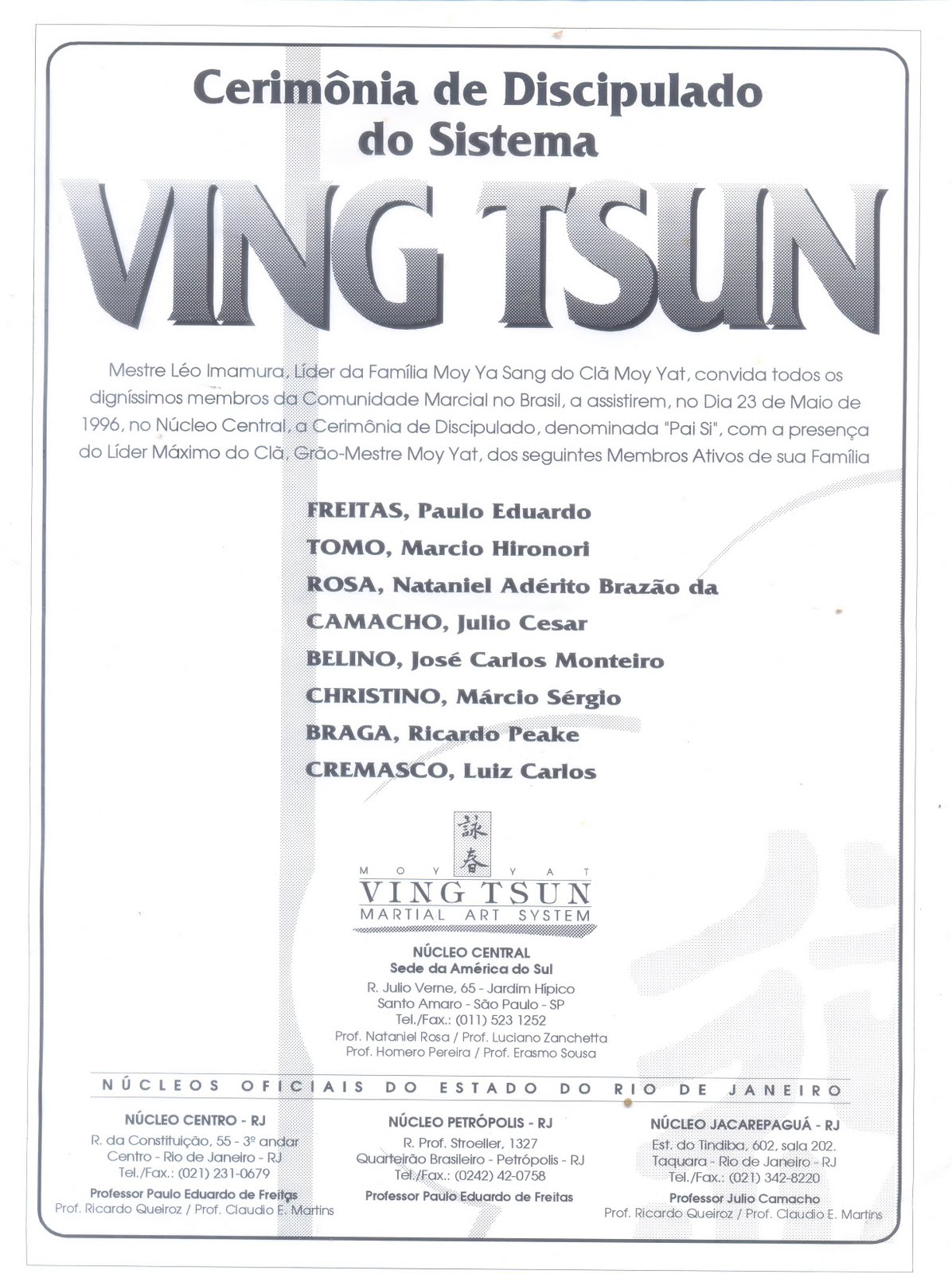
Convite publicado em revista especializada na qual
Grão Mestre Leo Imamura, convida a comunidade marcial do Brasil,
para participar da Cerimônia de Discipulado "Baai Si"(拜師).

Invitation published in a specialized magazine in which
Grandmaster Leo Imamura, invites the martial community of Brazil,
to participate in the "Baai Si" Discipleship Ceremony (拜師).
Meu Mestre Julio Camacho, nos anos seguintes, continuou honrando seu compromisso estabelecido com seu Mestre, o acompanhando em suas viagens internacionais (vemos na foto os dois ao lado do renomado Grão- Mestre  ,o lendário Sr. Micky Chan). Mas principalmente,meu Mestre sempre fala em estar em sintonia com seu Mestre, ainda que ambos morem em países diferentes.

My Master Julio Camacho, in the following years, continued to honor his commitment established with his Master, accompanying him on his international trips (we see in the photo the two together with the renowned Grand Master, the legendary Mr. Micky Chan). But mainly, my Master always talks about being in tune with his Master, even though both live in different countries.
 Meu Mestre, nas quase 20 viagens que fez a NY sempre fica hospedado na casa de
Grão-Mestre Miguel Hernandez. Na foto acima, vemos os dois praticando Chi Sau na loja esportiva deste último.

My Master, in the almost 20 trips he made to NY he always stays at Grand Master Miguel Hernandez's place. In the picture above, we see the two practicing Chi Sau in the latter's sports shop.
Meu Mestre (a esquerda na foto) investiu muito de seu tempo na Vida Kung-Fu com Grão-Mestre Leo Imamura, e graças a isso, participou de momentos que mais tarde se tornariam lendários dentro do Clã, como a famosa visita a esta escola de outra arte marcial no Kentucky,EUA.

My Master (left in the photo) invested a lot of his time in Kung-Fu Life with Grand Master Leo Imamura, and thanks to that, he participated in moments that would later become legendary within the Clan, such as the famous visit to this school of another martial art in Kentucky, USA.
Recebeu inúmeras lembranças, muitas delas feitas pelas próprias mãos de Patriarca Moy Yat.

He received numerous memorabilia, many of them made by Patriarch Moy Yat himself.
1998,Rio de Janeiro:
O quadro de patriarca Ip Man no boneco de madeira.

1998, Rio de Janeiro:
Patriarch Ip Man's picture on the wooden dummy.

Meu Mestre Julio Camacho auxilia seu Mestre durante demonstração nos anos 90.

My Master Julio Camacho assists his Master during a demonstration in the 90s.

Praticando nos EUA.

Practice in US.
Acompanhando seu Mestre Leo Imamura em treino noturno com Grão-Mestre Pete Pajil.

Accompanying his Master Leo Imamura in night training with Grand Master Pete Pajil.
Trabalhando na antiga sede mundial da MYVT nos Estados Unidos.

Working at MYVT's former world headquarters in the United States.

Com relação ao Discipulado["Baai Si"(拜師)], a manutenção e reforço deste vinculo vai, naturalmente com o decorrer do tempo, colocá-los em diferentes níveis dentro desta relação, ou ainda que não seja este o caso, os discípulos são categorizados de acordo com sua origem ou natureza:

With regard to Discipleship ["Baai Si" (拜師)], the maintenance and strengthening of this link will, naturally over time, place them at different levels within this relationship, or even if this is not the case, the disciples are categorized according to their origin or nature:

"Discípulo de Portas Abertas"(Hoi Mun Dai Ji)

"Hoi Mun Dai Ji" é o "discípulo de portas abertas". Por "portas" leia "Família" ou leia "Portas" como o objeto em si, mas nesse caso "portas abertas para discípulos".
Isso quer dizer que enquanto o Mestre não se aposenta de suas atividades, "as portas de sua 
Família Kung Fu estão abertas".

"Open Door Disciple" (Hoi Mun Dai Ji)

"Hoi Mun Dai Ji" is the "disciple with open doors". For "doors" read "Family" or read "Doors" as the object itself, but in this case "open doors for disciples".
This means that while the Master does not retire from his activities, "the doors of his
Kung Fu family are open ".

"Discípulo de Portas Fechadas"(Gwaan Mun Dai Ji)

Quando o Mestre se aposenta, ele não aceita mais discípulos. Portanto, as "portas se fecham". Porém, ocorrem exceções, e a mais famosa delas foi justamente Ip Man.
Ip Man começou seu Kung Fu quando seu Mestre Chan Wah Shun já estava aposentado. Por isso, Ip Man é um "Discípulo de Portas Fechadas"

"Closed Door Disciple" (Gwaan Mun Dai Ji)

When the Master retires, he no longer accepts disciples. Therefore, the "doors close". However, there are exceptions, the most famous of which was Ip Man.
Ip Man started his Kung Fu when his Master Chan Wah Shun was already retired. For this reason, Ip Man is a "Closed Door Disciple"

"Discípulo que entra na sala"(Yap Sat Dai Ji)

Um discípulo que tem muita proximidade com o Mestre está livre para entrar em recintos do local de treino (Mo Gun) ou da própria casa do Mestre, o que um discípulo comum não poderia.

"Disciple entering the room" (Yap Sat Dai Ji)

A disciple who is very close to the Master is free to enter the training area (Mo Gun) or the Master's own house, which an ordinary disciple could not.
Interessante dizer que, mesmo após se tornar um Mestre Classe Senior,meu Mestre continua honrando seu compromisso estabelecido em 1996 com seu Mestre, o Sr. Leo Imamura.
Ainda que os conteúdos do sistema tenham sido todos recebidos por ele, meu mestre acredita que apenas o convívio e a sintonia com seu Mestre. Cada vez mais farão dele um praticamente melhor, bem como, um homem melhor.

It is interesting to say that, even after becoming a  Senior Master, my Master continues to honor his commitment established in 1996 with his Master, Mr. Leo Imamura.
Even though the contents of the system have all been received by him, my master believes that it is only coexistence and attunement with his Master. More and more will make him better practitioner, as well as, a better man.


THE DISCIPLE OF MASTER JULIO CAMACHO
Thiago Pereira "Moy Fat Lei"
moyfatlei.myvT@gmail.com

sábado, 16 de maio de 2020

眼法 (NGAN FAAT) - SI FU´S SECRET ON HOW TO USE SIU NIM TAU WHEN SOMEONE IS BREAKING DOWN

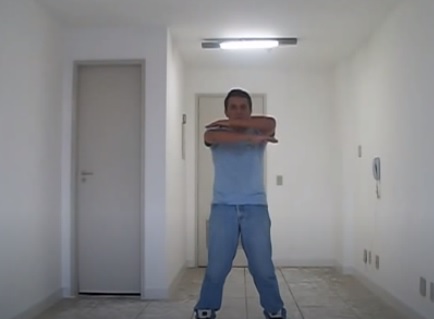
(Si Fu faz "Siu Nim Tau" no dia em que pegou as chaves
 da nova sala na Barra da Tijuca, Zona Oeste do Rio em 2004)

(Si Fu does the "Siu Nim Tau" on the day he took the keys
of the new room in Barra da Tijuca, West Zone of Rio in 2004)

Quando comecei a praticar o Ving Tsun, muito se dizia sobre a palavra "focar" relacionada ao Siu Nim Tau. Foram necessários doze anos para que eu pudesse resignificar esse entendimento, pois dizia-se naquele momento, que quando expandíamos os braços lateralmente na  altura dos ombros na segunda parte do Siu Nim Tau, deveríamos utilizar-nos da chamada "visão periférica".
Sem refletir sobre o tema com afinco, doze anos depois ao acompanhar meu Si Fu numa prática da minha irmã Kung Fu mais nova Cynthia Tong, ouvi de Si Fu que ela poderia "relaxar o olhar".
Si Fu teria dito que ao focarmos, tendemos a desconsideramos tudo que está à nossa volta. Segundo ele isso também acontecia com a "chamada visão periférica". Portanto, dizia Si Fu que ao relaxarmos o olhar, podemos perceber "o todo". Aquela fala me trouxe uma nova consciência sobre as informações que recebera doze anos antes, e que não me dediquei a amadurecer.

When I started practicing Ving Tsun, a lot was said about the word "focus" related to Siu Nim Tau. It took twelve years for me to reshape that understanding. For it was said at that time, that when we expanded our arms laterally at shoulder height in the second part of Siu Nim Tau, we should use the so-called "peripheral vision".
Without thinking hard about the theme, twelve years later, following my Si Fu teaching my younger Kung Fu sister Cynthia Tong, I heard from Si Fu that she could "relax her eyes".
Si Fu would have said that when we focus, we tend to disregard everything around us. According to him, this also happened with the so called "peripheral vision". Therefore, Si Fu said that when we relax our eyes, we can perceive "the whole". That speech brought me a new awareness of the information I had received twelve years earlier, and which I did not dedicate myself to maturing.

Quando falamos em "Faat"(法) em artes marciais chinesas, podemos estar nos referindo à inúmeras possibilidades. Podemos por exemplo estar nos referindo à "Sau Faat"(手法) que em um caso, podemos falar do "uso das mãos" em determinado estilo, Sistema ou momento de um Sistema de Variação. Porém, ainda que não muito evidenciado, algumas artes marciais fazem uso de um "法"(Faat) para os "Olhos"(眼 Ngan) o que chamaríamos de "Ngan Faat"(眼法).

When we speak of "Faat" (法) in Chinese martial arts, we may be referring to a myriad of possibilities. We may, for example, be referring to "Sau Faat" (手法) that in one case, we can speak of "the use of hands" in a certain style, System or moment of a System of Variation. However, although not very evident, some martial arts use an "Faat"(法) for" Eyes "(眼 Ngan) what we would call" Ngan Faat "(眼 法).
(Aqui eu faço "Siu Nim Tau" no dia em que peguei as chaves
 da nova sala na Méier, Zona Norte do Rio em 2011)

(Here I was doing the "Siu Nim Tau" on the day I took the keys
of the new room in Meier "Wild" Neighborhood, North Zone of Rio in 2011)


Quando tomamos como exemplo este trecho da segunda parte do Siu Nim Tau. Muitas pessoas preparam o movimento, e por só enxergar o momento do preparo e do ponto final da execução. Não estão conscientes do percurso dos braços ao longo dos 180º, e muito menos dos olhos.
Ademais o ideograma "Nim"(念) de "Siu Nim Tau", une dois ideogramas: O "Gam"(今) que se refere à um processo de algo "atual". E o "Sam"(心), que pode ser entendido por "consciência". Desta forma, conforme ouvi quando comecei nesta trajetória do Sistema Ving Tsun. O "Nim"(念) de "Siu Nim Tau" se refere à um processo de "atualizar a consciência", ou seja: De manter-se presente durante toda a trajetória do movimento, e não apenas quando ele começa ou quando ele termina.

When we take as an example this part of the second part of Siu Nim Tau. Many people prepare the movement, and just see the moment of preparation and the end point of the execution. They are not aware of the trajetory of the arms over 180 degrees, and also they are not aware of the eyes during this process.
In addition the ideogram "Nim" (念) of "Siu Nim Tau", unites two ideograms: "Gam" (今) that refers to a process of something "actual". And "Sam" (心), which can be understood as "conscience". In this way, as I heard when I started on this path of the Ving Tsun System. The "Nim" (念) of "Siu Nim Tau" refers to a process of "updating consciousness", that is: of being present during the entire trajectory of the movement, and not just when it starts or when it ends .
Portanto, quando expandimos nossos braços lateralmente, precisamos considerar também todas as possibilidades ao longo dessa expansão de 180º, e não apenas seu preparo e o final da execução. E mais: Como nos manter conscientes durante o movimento? Talvez seja o caso de executar os "Jiu Sik" em um timing de encadeamento que nos seja possível estar presente mentalmente.

Therefore, when we expand our arms laterally, we also need to consider all the possibilities throughout this 180º expansion, and not just its preparation and the end of the execution. And more: How to keep us conscious during the movement? Perhaps it is the case of executing the "Jiu Sik" in a timing chain that is possible for us to be present mentally.
Portanto, em um momento como esse que estamos vivendo, onde pessoas conseguem apenas se perceber como "saudáveis" ou "entubadas" numa UTI. Ou "Prósperas"ou "falidas". Nós poderíamos relaxar o nosso olhar, como sugeriu Si Fu à minha irmã Kung Fu. Para que assim como na expansão lateral dos braços da segunda parte do Siu Nim Tau. Possamos apreciar todas as possibilidades que se abrem para nós. E não apenas seus extremos. Não sejamos míopes, usemos Kung Fu com nossos olhos.

Therefore, at a time like the one we are living in, where people can only perceive themselves as "healthy" or "intubated" in an ICU. Or "Prosperous" and "bankrupt". We could relax our eyes, as Si Fu suggested to my Kung Fu sister . So that as in the lateral expansion of the arms of the second part of Siu Nim Tau. We can appreciate all the possibilities that are open to us. And not just its extremes. Let us not be shortsighted, let us use Kung Fu with our eyes.


The Disciple of Master Julio Camacho
Thiago Pereira "Moy Fat Lei"
moyfatlei.myvt@gmail.com

segunda-feira, 24 de fevereiro de 2020

LOVE IN CHINESE CULTURE PART 6: HONESTY AND LOVE IN BRUSSELS.


Às vezes quando fecho os olhos e lembro de quando estivemos na Europa, tudo parece um sonho. E nesse sonho real, um dos lugares em que estivemos foi Bruxelas, na Bélgica.
Desembarcamos no aeroporto de Bruxelas, e sem maiores problemas nos dirigimos ao estacionamento onde chamei um Uber. O dia já estava quase no fim e fazia frio. De repente, um homem de origem árabe chegou com um carro preto muito bonito. Ele era sério e estava bem vestido. Nos ajudou a colocar as malas no carro, e sem falar mais nada, começou a dirigir.
No som do carro, tocavam músicas em árabe e o locutor também falava em Árabe. E uma música em especial tocava sem parar, a qual infelizmente nunca descobri o nome. E mesmo, mais tarde já no Brasil, baixei o aplicativo daquela estação chamada "ARABEL", mas a tal música nunca mais tocou...

Sometimes when I close my eyes and remember when we were in Europe, everything feels like a dream. And in that real dream, one of the places we were in was Brussels, Belgium.
We got off at Brussels airport, and without any problems we headed to the parking lot where I called an Uber. The day was almost over and it was cold. Suddenly, a man of Arab origin arrived with a beautiful black car. He was serious and well dressed. He helped us to put our bags in the car, and without saying anything else, he started driving.
In the car stereo, songs played in Arabic and the speaker also spoke in Arabic. And one song in particular played over and over, which unfortunately I never found the name. And even, later in Brazil, I downloaded the app of that radio station called "ARABEL", but that song never played again ...
(Na Praça Saint Catherine em Bruxelas com Si Fu e Claudio Teixeira)
(At Saint Catherine Place in Brussels with Si Fu and Claudio Teixeira).

Eu havia estudado Bruxelas e andava com um livreto cheio de anotações sobre lugares interessantes para visitar. Acontece que Si Fu simplesmente falava: "Vem cá! Vamo' por ali ó!"
Após chegarmos ao razoável hotel Ibis City Centre na rua Joseph Plateau nº 2, tivemos cerca de uma hora para nos recompormos da viagem desde a Polônia, e nos encontramos no saguão do hotel. Estava frio suficiente do lado de fora para finalmente usar minha querida touca da Adidas comprada em Lisboa, mesmo sob protestos de Si Fu, que não achou ela tão bonita como eu achei.
Andamos um pouco para decidirmos onde poderíamos jantar, e escrevendo agora, bate uma saudade daqueles momentos...

I had studied Brussels and had a booklet full of notes about interesting places to visit. It turns out that Si Fu simply used to say: "Come here! Let's go over there!"
After arriving at the reasonable Ibis City Centre hotel on Joseph Plateau Street  , we had about an hour to recover from the trip from Poland, and found ourselves in the hotel lobby. It was cold enough outside to finally wear my beloved Adidas cap bought in Lisbon, even under protests from Si Fu, who didn't think it was as cool as I think.
We walked a little to decide where we could have dinner, and writing now, I miss those moments ...
Achamos uma churrascaria(FOTO) brasileira (risos) no meio da Praça Saint Catherine. E resolvemos entrar. Nem todo mundo falava inglês, e isso incluia o garçom que nos atendeu. Ele estava muito atrapalhado. Fomos salvos por um garçom português que ficou nosso amigo e nos servia a carne do rodízio primeiro(risos). Foi então que perguntei à Si Fu, se havia problema pedir uma cerveja... Porém, mal eu sabia que receberia uma grande lição sobre amor e honestidade....

We found a Brazilian steakhouse (PHOTO) (laughs) in the middle of Saint Catherine Square. And we decided to enter. Not everyone spoke English, and that included the waiter who served us. He was very upset. We were saved by a Portuguese waiter who became our friend and served us the meat of the "rodizio" service ,first (laughs). It was then that I asked Si Fu if it was okay to order a beer ... However, little did I know I would receive a great lesson on love and honesty ....
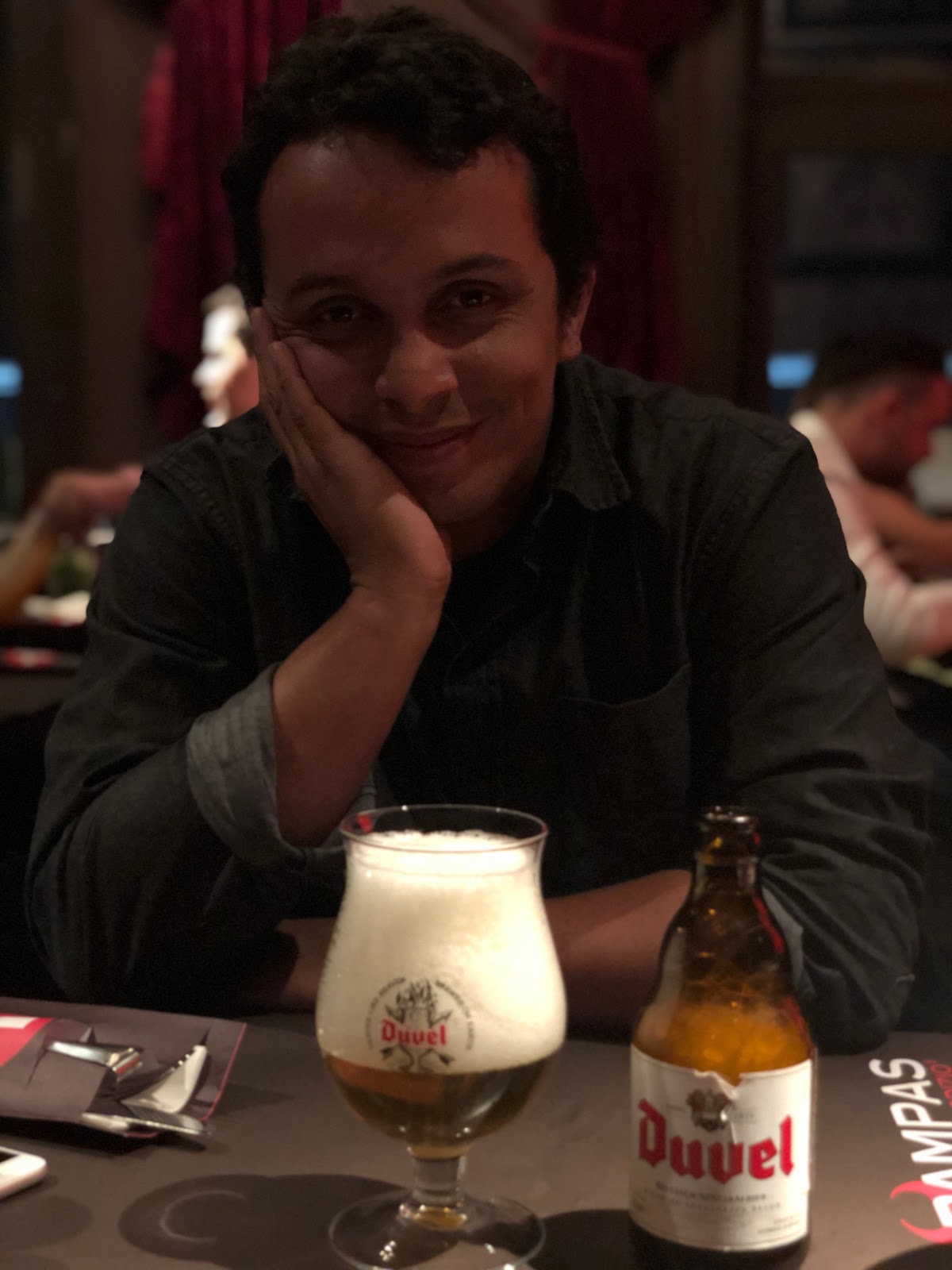
Fiz um registro de Si Fu(FOTO) com o específico copo para a cerveja que tomaríamos (Não poderia ser diferente logo na Bélgica!), e Si Fu pediu me pediu o celular, para ele fazer um registro meu também...

I made a record of Si Fu (PHOTO) with the specific glass for the beer that we would have (It couldn't be different soon in Belgium!), And Si Fu asked me for my cell phone, so he could make a photo of mine too ...
Quando fiz essa pose, Si Fu tirou os olhos da câmera e olhando além da tela do telefone, me mirou com eles e perguntou: "É sério, Pereira?" . Meu irmão Kung Fu, Claudio Teixeira começou a rir. E comentou brincando: "Acho que ele vai colocar no Tinder, Si Fu".  E todos riram... (Risos).

When I did this pose, Si Fu took his eyes off the camera and looking beyond the phone screen, looked at me with them and asked: "Are you serious, Pereira?" . My Kung Fu Brother, Claudio Teixeira started to laugh. And he jokingly commented: "I think he will put it on Tinder, Si Fu". And everyone laughed ... (Laughter).
Depois que os risos cessaram, Si Fu me pediu para explicar como eu fazia para conquistar uma pessoa. Eu achei que ele estivesse brincando, mas não era o caso.
Si Fu me conhece desde os quinze anos de idade, e talvez por isso, parece sempre saber onde vou chegar com minha linha de raciocínio. Assim, ele amarra ao final, uma lição que costumo carregar comigo depois.
Em poucas linhas, expliquei a ele uma coisa ou outra, uma frase ou outra... Claudio riu e Si Fu também. Porém, Si Fu disse: "Por que você não tenta ser honesto nessas horas, Pereira?Sem camdas a mais?"

After the laughter stopped, Si Fu asked me to explain how I behave myself in a date. I thought he was kidding, but that was not the case.
Si Fu has known me since I was fifteen years old, and maybe that's why he always seems to know where I'm going with my line of reasoning. Thus, he ties up at the end, a lesson that I usually carry with me later.
In a few lines, I explained one thing or the other, a sentence or two ... Claudio laughed and Si Fu laughed. However, Si Fu said: "Why don't you try to be honest at these times, Pereira? Without any extra layers?"


Dentro de minhas vivências,descobri que existem diversas formas de se falar a palavra "Herói" em chinês, sendo algumas delas bem específicas para o tipo de herói do qual se quer falar. Uma delas, se tornou mundialmente conhecida, pois é o título do filme "Herói" de 2002 (FOTO acima).
No título desse filme, "Herói" se escreve com os ideogramas: 英雄 , transliterando-se em cantonês como "Jing Hung".
Porém, foi em 2010 enquanto passava a noite separando materiais com Si Gung e Si Suk Navarro na antiga "Casa dos Discípulos", que Si Gung me mostrou a capa de uma revista famosíssima chamada "San Mo Hap" que significa algo como "Os novos heróis marciais". Porém, prefiro chamá-la de "Os novos Mou Hap".

Within my experiences, I discovered that there are several ways to speak the word "Hero" in Chinese, some of which are very specific to the type of hero you want to talk about. One of them became known worldwide, as it is the title of the 2002 film "Hero" (PHOTO above).
In the title of this film, "Hero" is written with the ideograms: 英雄, transliterating into Cantonese as "Jing Hung".
However, it was in 2010 while spending the night separating materials with Si Gung and Si Suk Navarro in the old "House of Disciples", that Si Gung showed me the cover of a very famous magazine called "San Mo Hap" which means something like "The new martial heroes". However, I prefer to call it "The new Mou Hap".
(O ator sino-japonês Takeshi Kaneshiro, interpreta um "Mo Hap" (武俠), 
no filme "O Clã das Adagas Voadoras" de 2004)

(Sino-Japanese actor Takeshi Kaneshiro, plays a "Mo Hap" (武俠),
 in the 2004 movie "House of the Flying Daggers")


"Mo Hap" (武俠), é um termo diferente de  "Jing Hung"(英雄) usado por Zhang Yi Mou como título original de sua obra prima "Herói"(2002), conforme citado acima.  Isso acontece, porque "Mo Hap" (武俠) é um "Herói" que vive num mundo imanente chamado "Gong Wu"(江湖), presente nos romances chineses que tratam das artes marciais. E graças ao filme "O Tigre e o Dragão"(Crouching Tiger Hidden Dragon,2000) que foi todo falado em mandarim. A pronúncia em mandarim deste termo ficou mais conhecida no ocidente : "Jiang Hu", que significa "Rios e Lagos".
Assim, se os artistas marcias vivem numa sociedade imanente chamada "Mo Lam"(武林), os artistas marciais dos romances chineses vivem no equivalente chamado "Gong Wu"(江湖) ou "Jiang Hu"(em mandarim).

"Mo Hap" (武俠), is a different term from "Jing Hung" (英雄) used by Zhang Yi Mou as the original title of his masterpiece "Hero" (2002), as mentioned above. This is because "Mo Hap" (武俠) is a "Hero" who lives in an immanent world called "Gong Wu" (江湖), present in Chinese novels dealing with martial arts. And thanks to the movie "Crouching Tiger Hidden Dragon"(2000) which was all spoken in Mandarin. The Mandarin pronunciation of this term became better known in the West: "Jiang Hu", which means "Rivers and Lakes".
Thus, if Martian artists live in an immanent society called "Mo Lam" (武林), martial artists in Chinese novels live in the equivalent called "Gong Wu" (江湖) or "Jiang Hu" (in Mandarin).


De volta ao jantar com Si Fu e Claudio na churrascaria em Bruxelas. Senti como se aquela noite leve e o jantar divertido, mudassem de repente de tom. Talvez tenha feito uma expressão de quem não compreendeu a dimensão do que Si Fu dizia, quando  me indagou porque eu não era "honesto sobre quem de fato eu era" nas relações com mulheres. Porém,  para me ajudar ele continuou: "Lembra da entrevista do Bruce Lee, em que ele diz que o último nível de um artista marcial é ser honesto?" - Fiz que sim com a cabeça. - "Então... O problema de se relacionar com camadas escondidas Pereira, é que podem acontecer duas coisas: Ou você acha que se você for você mesmo e não a personagem que você criou, a pessoa não vai gostar tanto de você. Ou, você vai cansar de viver essa personagem...Porque uma hora cansa..." - Si Fu encerrou depois de uma pequena pausa, com uma piada sobre ser honesto... Todos riram. Então era como se ele fosse um maestro, mudando mais uma vez o tom da conversa e tornando ela leve novamente. Porém, aquelas palavras me fizeram refletir. Afinal, muitos de nossos comportamentos, simplesmente não percebemos. E o provimento de "Vida Kung Fu", tem esse potencial de tomada de consciência.

Back to dinner with Si Fu and Claudio at the steakhouse in Brussels. I felt like that light night and the fun dinner suddenly changed its tone. Perhaps I made an expression of someone who did not understand the dimension of what Si Fu said, when he asked me why I was not "honest about who I really am" in relationships with women. However, to help me, he then continued:: "Do you remember Bruce Lee's interview, where he says that the last level of a martial artist is to be honest?" - I said "yes" with my head. - "So ... The problem  when you hide layers in a relationship, Pereira. Is that two things can happen: Or do you think that if you are yourself and not the character you created, the person will not like you so much. Or , you will get tired of living this character ... Because one hour you will get tired ... "- Si Fu ended after a short pause, with a joke about being honest ... Everyone laughed. So it was like he was a Maestro, changing the tone of the conversation making it light again. However, those words made me reflect. After all, many of our behaviors, we just don't notice. And the provision of "Kung Fu Life", has this potential for awareness.
O filme "O Clã das Adagas Voadoras"(House of the Flying Daggers,2004), é a continuação de "Herói"(2002). E este filme, até mais do que o anterior, deixa bem claro que toda a história se passa em "Rios e Lagos"["Gong Wu"(江湖) ou "Jiang Hu"(em mandarim)].
Em um dos episódios de seu programa no canal "Kung Fu Life"(FOTO acima), meu Si Gung Leo Imamura, indaga o espectador, sobre como seria possível que dois dos personagens principais, se apaixonassem em apenas três dias. E sobre isso, ele diz que a resposta pode ser entendida através da expressão "Experiência Significativa". Si Gung diz que esta experiência mobilizadora, diz respeito a um momento em que rompemos com nossas crenças individualistas, através de um desnível do que se experimenta e do que se crê. Ele complementa, dizendo que nessa "Experiência Significativa", nossa conduta individualista é rompida por uma percepção transindividual, onde o sentimento de humanidade, é aflorado, a partir do reconhecimento da existência do outro.

The 2004 movie "House of the Flying Daggers".Is the sequence of "Hero" (2002). And this film, even more than the previous one, makes it very clear that the whole story takes place in "Rivers and Lakes" ["Gong Wu" (江湖) or "Jiang Hu" (in Mandarin)].
In one of the episodes of his program on the channel "Kung Fu Life" (PHOTO above), my Si Gung Leo Imamura, asks the viewer, about how it would be possible for two of the main characters to fall in love in just three days. And about that, he says the answer can be understood through the expression "Significant Experience". Si Gung says that this mobilizing experience concerns a moment when we break with our individualistic beliefs, through a gap in what is experienced and what is believed. He complements, saying that in this "Significant Experience", our individualistic conduct is broken through a transindividual perception, where the feeling of humanity is touched on, based on the recognition of the existence of the other.


(Com o "Manekken Pis"ao fundo.)
(With Si Fu, Claudio and the "Manekken Pis" in the background)

Isso casa bem com o que Si Fu disse a mim enquanto caminhávamos juntos certa vez em direção ao antigo Restaurante Deli Delícia, para almoçarmos na Barra da Tijuca. Segundo ele, o trabalho de um Si Fu no que diz respeito ao desenvolvimento humano de um To Dai. Não tem a ver com colocar mais coisas, mas de ajudar o To Dai a retirar camadas, que o impedem de se expressar como ser humano. E naquele momento, naquela mesa de restaurante em Bruxelas, foi exatamente o que aconteceu. Passei a entender de repente, como usava técnicas que me impediam de me expressar como eu de fato sou. 

This matches well with what Si Fu said to me as we walked together once towards the old Deli Delícia Restaurant, to have lunch in Barra da Tijuca. According to him, the work of a Si Fu with regard to the human development of a To Dai. It is not about adding more things, but about helping To Dai remove layers, which prevent him from expressing himself as a human being. And at that moment, at that restaurant table in Brussels, that's exactly what happened. I suddenly understood how I used techniques that prevented me from expressing myself as I really am.
(Trabalho artístico ilustrando a personagem de Zhang Zhi Yi 
no filme "O Clã das Adagas Voadoras")

(Artwork illustrating the character of Zhang Zhi Yi
in the film "The House of the Flying Daggers")


Si Gung então finaliza seu raciocínio sobre o filme de Zhang Yi Mou, dizendo que ao tomarmos consciência do outro, o tempo se dissolve. E com isso, as noções temporais se tornam relativas. 
E é o que se vê no filme, no qual bastaram-se apenas três dias, em que dois humanos se apaixonassem, em função das experiências significativas que vivenciaram nesse período. 

Si Gung then finishes his lecture about the Zhang Yi Mou film, saying that when we become aware of the other, time dissolves. And with that, temporal notions become relative.
And that's what you see in the film, in which it took just three days, in which two humans fell in love, due to the significant experiences they had during that period.
(No centro da movimentada área de Grand-Place de Bruxelas está localizada a praça com o mesmo nome, à vista das torres a qual Si Fu observa, em estilo gótico da prefeitura e cercada pelas sedes exuberantes das corporações de ofício com cafeterias e o museu do chocolate Choco-Story)

(In the center of the bustling Grand-Place area of Brussels is the square with the same name, in view of the towers that Si Fu observes, in the Gothic style of the city hall and surrounded by the exuberant headquarters of the craft corporations with cafeterias and the museum Choco-Story)


Si Fu já me disse mais de uma vez por razões diferentes, mas que aqui, me atenho ao contexto do artigo: "Pereira, você é um dos caras mais inteligentes, e mais burros que conheço também". 

Si Fu has already told me more than once for different reasons, but here, I stick to the context of the article: "Pereira, you are one of the smartest, and also ,dumbest persons I know".

Curiosamente, em uma cena de outro clássico sobre "Mo Hap" (武俠) de 2000 chamado "O Tigre e o Dragão"(Crouching Tiger Hidden Dragon) do genial Ang Lee. O personagem Sir Te diz algo parecido a Shu Lien. Ele tenta alertá-la sobre não ela não estar sendo capaz de enxergar os sentimentos de Li Mu Bai, mas a convicção dela, atrapalha seu discernimento. Sobre isso, Sir Te diz: "...Quando diz respeito à sentimentos, mesmo os 'Mo Hap' (武俠) podem ser idiotas..."
Talvez, a personagem Shu Lien, faltasse a experiência significativa que causaria o desnível, sugerido por Si Gung em seu canal, entre o que se experimenta e o que se crê. 

Interestingly, in a scene from another 2000 classic about "Mo Hap" (武俠) called "Crouching Tiger Hidden Dragon", by the brilliant Ang Lee. The character Sir Te says something similar to Shu Lien. He tries to warn her about not being able to see Li Mu Bai's feelings, but her conviction hinders his judgment. About this, Sir Te says: "... When it comes to feelings, even 'Mo Hap' (武俠) can be idiots ..."
Perhaps, the character of Shu Lien, lacked the significant experience that would cause the gap, suggested by Si Gung in his channel, between what is experienced and what is believed.
(Com Si Fu e Claudio nas "Galeries Royales Saint-Hubert" próximo a Grand-Place de Bruxelas)

(With Si Fu and Claudio at "Galeries Royales Saint-Hubert" near Grand Place in Brussels)

E claro, que o mesmo já me fez e por vezes ainda faz muita falta. Mas por sorte, eu tenho um Si Fu.

Of course, the same thing has already done to me and is sometimes still sorely missed. But luckily, I have a Si Fu.


The Disciple of Master Julio Camacho
Thiago Pereira "Moy Fat Lei"
moyfatlei.myvt@Gmail.com