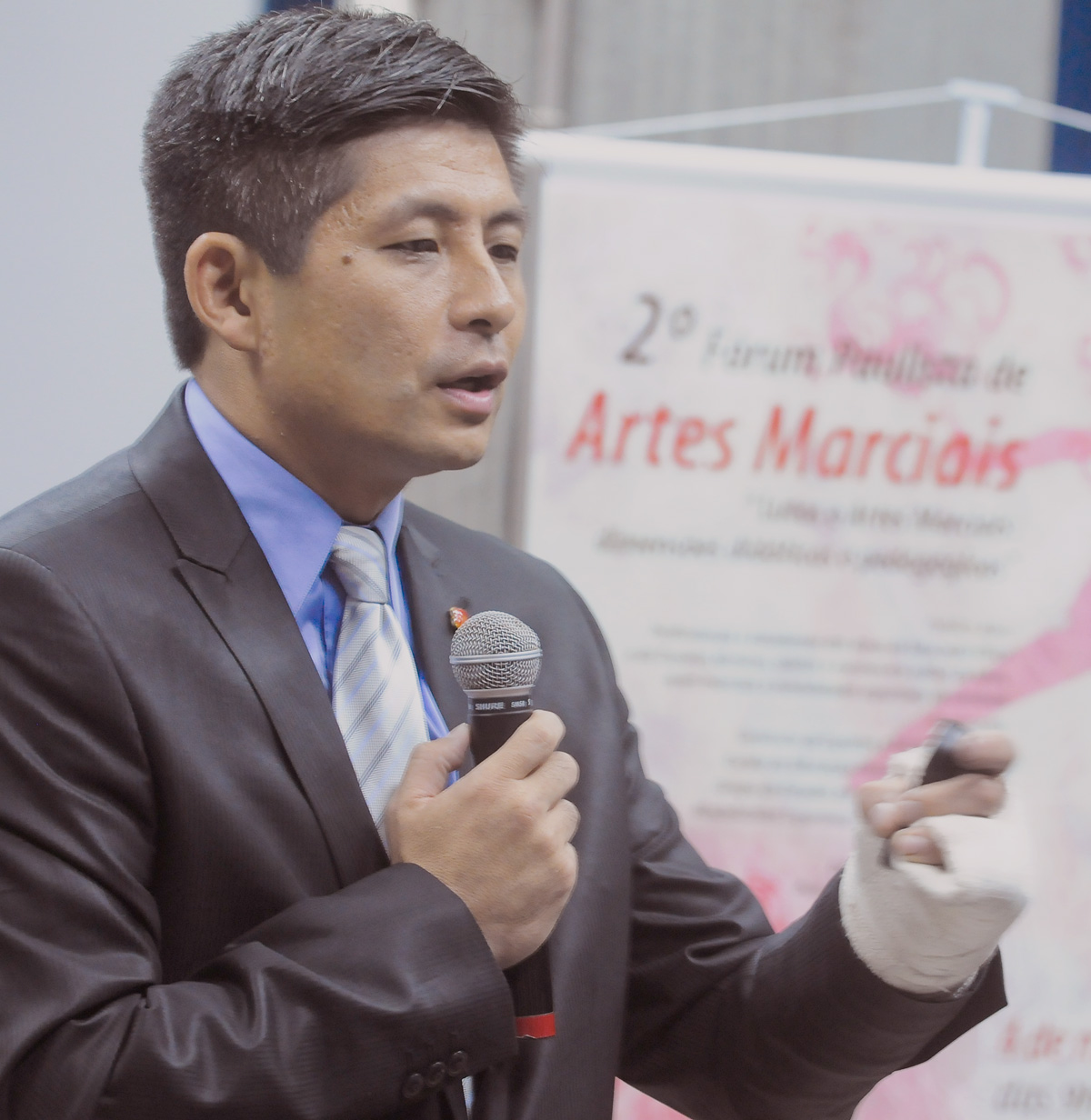
O homem na foto é o Mestre Senior pela Moy Yat Ving Tsun Martial Intelligence, responsável por dois de seus Núcleos diretamente no Rio de Janeiro e hoje, é o membro mais antigo desta instituição neste estado da região sudeste do Brasil.
No último dia 29 de Agosto, seu trabalho de mais de vinte anos alcançou um novo patamar quando dois de seus discípulos, Leonardo Reis e Thiago Pereira, alcançaram o Título de Mestre Qualificado .
Isso fez de Mestre Julio, o primeiro em formar dois mestres de décima segunda geração na América Latina, e hoje, vamos assistir abaixo um pouco desta noite que entrou para a história de nosso Clã:
The man in the photo is the Senior Master the Moy Yat Ving Tsun Martial Intelligence, directly responsible for two of its schools in Rio de Janeiro and today, he is the oldest member of this institution in this state of southeastern Brazil.
Last 29 August, his work over twenty years reached a new level when two of his disciples, Leonardo Reis and Thiago Pereira, achieved the Qualified Master Title .
It made Master Julio, the first to form two masters of twelfth generation in Latin America, and today, we will watch below a little bit about that night that went down in history of our Clan:
A disciple of Master Julio Camacho
Thiago Pereira "Moy Fat Lei'
moyfatlei.myvt@gmail.com
sexta-feira, 18 de setembro de 2015
quarta-feira, 16 de setembro de 2015
Master Julio visits Faat Saan, Ip Man's homeland
(Si Fu e Si Suk Fabio Gomes chegam a Faat San (Fo Shan))
(Si Fu and Si Suk Fabio Gomes arrives in Faat San (Fo Shan))
No final de 2006, meu Si fu Julio Camacho, líder do Clã Moy Jo Lei Ou do Rio de Janeiro, fez uma viagem histórica a Faat Saan(Fo Shan) e Hong Kong, com uma comitiva dos E.U.A. que contava com a esposa de grão-mestre Moy Yat, Sra. Helen Moy.
Nesta viagem, Si fu e Si suk Fabio Gomes, além de Si suk Marcelo Abreu ,que na ocasião residia na China e era uma pessoa fundamental nesta viagem, representaram o Brasil visitando lugares históricos para o Ving Tsun e o Kung Fu em geral(Como a residência dos dois discípulos do Patriarca Ip Man em Faat Saan,o IP MAN TONG, museu de Ip Man,a famosa escola Jing Wu de Hua YuanJia ,etc...). Além disso, puderam obviamente ter experiências práticas com membros de outras Famílias além de terem reunido milhões de histórias divertidíssimas, que tentarei lembrar de todas que ouvi do Si fu para relatar aqui.
In late 2006, my Si Fu Julio Camacho, Leader of the Moy Jo Lei Ou Clan in Rio de Janeiro, made a historic trip to Faat Saan(Fo Shan) and Hong Kong, with a US delegation that had the wife of Grand Master Moy Yat, Mrs. Helen Moy as the leader.
On this trip, Si Fu and Si Suk Fabio Gomes, and Si Suk Marcelo Abreu who at the time lived in China and was a key person in this journey, represented Brazil visiting historical places for Ving Tsun and Kung Fu in general (As residence of the two disciples of Patriarch Ip Man in Faat Saan, IP MAN TONG, museum of Ip Man, the famous school Jing Wu of Hua Yuanjia, etc ...). In addition, they could obviously have practical experiences with members of other families as well as bringing together millions of stories, I'll try to remember all that I have heard from Si fu to report here.
A fama de Foshan está nas artes de combate. Desde a dinastia Ming (1368-1644), tem sido um centro de formação de artes marciais e no final da Dinastia Qing (1644-1912), e primeiros dias da República Popular da China a influência das organizações de artes marciais na cidade começou a se espalhar internacionalmente.
Os estilos de artes marciais Ving Tsun Kuen, Choy Li Fut e Hung Kuen todos floresceram em Faat San (Foshan), e muitos dos mais conhecidos mestres de kung fu do mundo são da cidade, incluindo Ip Man e Wong Fei-hung.
Mas, enquanto as artes marciais são que atrai muitos viajantes a "Faat San"(Foshan), é também um lugar perfeito para experimentar a moderna China industrial que moldou os mercados globais nas últimas décadas.
Localizado no sul da província de Guangdong ao longo do trecho norte do Rio das Pérolas, a cidade é composta por cinco distritos: Shunde, Gaoming, Chancheng, Nanhai e Sanshui, que se estendem para fora através de 3.840 quilômetros quadrados com uma população de cerca de 7,1 milhões.
É uma importante base industrial, que se beneficia de suas ligações estreitas com Guangzhou, com as quais compartilha história considerável e cultura, e sua posição entre sudeste e leste da Ásia.
É também a cidade natal de muitos chineses que saíram da China - cerca de 1,4 milhões de chineses chamam Faat Saan(Foshan) casa - possivelmente como resultado de suas conexões comerciais internacionais.
A reputação de Faat Saan(Foshan) como uma cidade de comércio não é um fenômeno moderno.
Nas dinastias Ming e Qing já era conhecida em toda a China como uma cidade de negócios. Primeiro pelas fábricas de seda e outros negóciosdo país foram estabelecidos em Faat Saan(Foshan)
Hoje, Faat Saan(Foshan) é a terceira maior base de produção no Delta do Rio das Pérolas, depois de Shenzhen e Guangzhou.
Já foi uma vez o lar de empresas de propriedade estatal da China, mas sua atual força econômica reside no sector privado.
Muitas marcas bem conhecidas, incluindo Jianlibao, Midea e Kelon são baseados na cidade. É também uma importante base para o mobiliário e iluminação indústrias internacionais. (Fonte: China Daily)
Faat Saan (Foshan)'s fame lies in the martial arts. Since the Ming Dynasty (1368-1644) it has been a center for martial arts training and in the late Qing Dynasty (1644-1912), and early days of the Republic of China the influence of martial arts organizations in the city began to spread internationally.
The fighting styles Ving Tsun (Wing Chun) Kuen, Choy Li Fut and Hung Kuen all became famous in Faat Saan (Foshan), and many of the world's best-known kung fu masters are from the city, including Ip Man and Wong Fei-hung.
But while martial arts is what draws many travelers to Faat Saan (Foshan), it is also a perfect place to experience the modern industrial China that has shaped global markets in recent decades.
Located in the southern province of Guangdong along the northern stretch of the Pearl River, the city is made up of five districts: Shunde, Gaoming, Chancheng, Nanhai and Sanshui, which stretch out across 3,840 square kilometers with a population of about 7.1 million.
It is an important industrial base, which benefits from its close connections with Guangzhou, with which it shares considerable history and culture, and its position between southeast and eastern Asia.
It is also the hometown of many overseas Chinese - about 1.4 million call Foshan home - possibly as a result of its international business connections.
Foshan's reputation as a city of commerce is not a modern phenomenon.
In the Ming and Qing dynasties it was already known across China as a business city. The country's first matchstick factory and silk reeling business were established in Foshan.
Today, Foshan is the third-largest manufacturing base in the Pearl River Delta, after Shenzhen and Guangzhou.
It was once home to many China's state-owned enterprises, but its current economic strength lies in the private sector.
Many well-known brands, including Jianlibao, Midea and Kelon are based in the city. It is also a major base for the international furniture and lighting industries (Font: China Daily)
(Si Suk Fabio Gomes, Si Fu e Si Suk Marcelo Abreu na entrada do Museu da Ópera Cantonesa)
Si Suk Fabio Gomes, Si Fu and Si Suk Marcelo Abreu in front of the Cantonese Opera Museum)
Alguns tolos gostariam de visitar a China porque pensam que se pararem para comer em algum restaurante, uma briga de proporções de um Wu Xia pode acontecer.
O praticante de arte marcial de verdade, nutre uma estranha ligação com o local de origem de sua arte, mas não uma ligação fantasiosa, e sim, uma ligação inteligente, uma ligação que faz com que ele não queira perder tempo visitando lugares oque viu em filmes, e sim lugares que realmente valem a pena conhecer, e que tem relevância para a arte a qual se dedica.
Some fools would like to visit China because they think that if they stop to eat in a restaurant, a brawl like in a Wu Xia * could happens.
The intelligent martial art practitioner actually nourishes a strange connection to the place of origin of their art, but not a fanciful connection, but rather an intelligent connection, a connection that makes him not want to waste time visiting places which saw in movies, but places that really are worth exploring, and that has relevance to the art which is dedicated ..
Si Suk Marcelo Abreu, havia pedido que sua esposa, Si Suk Ming, mandasse um Taxi esperar por Si Fu e Si Sok Fabio no aeroporto e avisou a Si fu que algo como: "Julio Camacho, há muito tempo a China aguarda essa visita" , estaria escrito na placa que o taxista de nome Cheng estaria segurando.
Si Fu conta que ainda imaginou que nada disso estaria escrito, mas que "Julio Camacho" numa plaquinha ele realmente acharia por lá..rs
Porém, Si Fu conta que já no aeroporto de Guangzhou, não havia nenhum Cheng, nem plaquinha, até que de repente surge um pequeno chinês dizendo aos berros e apontando para ele:"BA SAI?! BA SAI?!" (Brasil?! Brasil?!)
(É, eu também imaginei o garotinho Chinês de "Indiana Jones e o Templo da Perdição"[foto] , mas não era..rs)
Si Suk Marcelo Abreu, had asked his wife, Si Suk Ming, to send a taxi for Si Fu and Si Suk Fabio at the airport and told Si fu that the taxi driver would be holding a plaque with something like: "Julio Camacho, for a long China is waiting for this visit" ,
However, Si Fu said that already in the Guangzhou airport, there was no Taxi Driver called Cheng, or plaque, until suddenly comes a little Chinese saying screaming and pointing to him: "BA SAI ?! BA SAI ?!"
(Yes, I also thought the Chinese boy from "Indiana Jones and the Temple of Doom" [photo] but was not him)
A história do Templo Jo Miu(Foto) pode ser rastreada até a Dinastia Song do Norte (960-1127). Foi construído em dedicação ao Deus do Norte, que foi dito para manter o poder sobre as águas de Guangdong, e às vezes era chamado o Templo Deus do Norte.
Cobrindo 3.500 metros quadrados, o templo foi incendiado durante a Dinastia Yuan tarde (1271-1368) e foi reconstruída no quinto ano do período Hongwu (1368-1398) da dinastia Ming.
O templo inclui o Wanfu Palco, Sanmen Gate, Lingying Archway, Jinxiang Pool, Qingzhen edifício, o Bell and Drum Tower, um hall de entrada e um salão principal. Todos os móveis do templo e os materiais utilizados na sua construção foram doados por empresas locais e assim refletir a cultura industrial da cidade.(fonte: China Daily)
Segundo Si Fu, na China existem muitos parques como "Bosque da Barra"(Rio) e um pouco menores do que o Ibirapuera (SP), geralmente também são enormes complexos como o desse templo, onde várias pessoas vão para treinar kung fu, praticar esportes e no caso desse,o patriarca Ip Man praticava Ving Tsun .
The history of Jo Miu Temple can be traced back to the Northern Song Dynasty (960-1127). It was built in dedication to the Northern God, who was said to hold power over the waters of Guangdong, and was sometimes called the Northern God Temple.
Covering 3,500 square meters, the temple it was burnt down in the late Yuan Dynasty (1271-1368) and was rebuilt in the fifth year of the Hongwu Period (1368-1398) of the Ming Dynasty.
The temple includes the Wanfu Stage, Sanmen Gate, Lingying Archway, Jinxiang Pool, Qingzhen Building, the Bell and Drum Tower, a front hall and a main hall. All the temple furnishings and materials used to construct it were donated by local businesses and so reflect the city's industrial culture. (Font China Saily)
According to Si Fu in China there are many parks as "Bosque da Barra" (Rio) and somewhat lower than the Ibirapuera (Sao Paulo), generally they are also huge complexes like this temple, where several people are going to practice kung fu, practice sports and in this case, the Patriarch Ip Man from Ving Tsun used to practice there.
The most important is to understand that both Ip Man as Wong Fei-hung and many other exponents that appeared in Faat Saan (Fo Shan) as Faat Saan Jaan Sing Sang. Had no idea that one day, in something called Internet someone would write about the city on account of their deeds. So when we realize that we are making history all the time, we understand that in 50 years or more from now, your city or neighborhood could be upgraded to the next level for you. You might not see it in life, but posterity may do so on your behalf. After all, "A man could last for a lifetime but a name lasts forever ..."
A Disciple Of Master Julio Camacho
Thiago Pereira "Moy Fat Lei"
moyfatlei.myvt@gmail.com
terça-feira, 15 de setembro de 2015
(The importance of the "Dui Ying (對形)" in Ving Tsun ) A importância do "Dui Ying (對形)" no Ving Tsun
(Mestre Diego Guadelupe debate sobre "Jong Sau"樁手 com Luciano Freitas, enquanto Cris Chaves acompanha.Tanto Luciano quanto Cris, são discípulos de Mestre Julio Camacho assim como eu.)
(Master Diego Guadelupe talks on "Jong Sau" 樁 手 with Luciano Freitas, while Cris Chaves watches . Luciano and Cris, are disciples of Master Julio Camacho just like me.)
O que chamamos de "posição de guarda" no Ving Tsun, recebe o nome de "Jong Sau"(樁手). Essa posição que mantém as duas mãos à frente do corpo, nos causa desconforto num primeiro momento. Pois a tendência é que estejamos comprometidos apenas em parte com a situação. Ou seja: De lado . De forma que um lado do corpo alcança o adversário e a outra precisa percorrer uma distância maior para tal.
What we call "guard position" in Ving Tsun, is called "Jong Sau" (樁 手). This position keeps both hands in front of one's body, this may cause some discomfort at first. Because the trend is that we are committed only in part with the situation. Ie: With the Side of our body. In order that a side of the body reaches the opponent and the other must travel a greater distance to such.
The "Jong" (樁) of "Jong Sau" (樁 手) is the same ideogram found in "Muk Yan Jong" (木人 樁). Thus, its meaning is "Post" or "pillar". In this case, the "pillar" would be our body. Protected by the "Sau" (手). That although the in the dictionary means "hand" in terms of Kung Fu, we can consider "Sau" (手) as the entire shoulder extension to the fingers.
(Si Fu demonstra o Siu Nim Tau)
(Si Fu does the Siu Nim Tau)
Ficamos de frente para adversário na prática do Ving Tsun , porém, se apenas ficarmos de frente para ele , e ele também estiver de frente para nós. De nada adiantará, pois as distâncias serão equivalentes e possivelmente o ponto de referência(foto) estará compartilhado pelos dois.
Desta forma, "ficar de frente" para o adversário, é chamado de "Dui Ying (對形)". Acontece que estar em "Dui Ying (對形)" a partir do Cham Kiu, significa se antecipar para se posicionar de frente para o adversário, de forma que ele não esteja totalmente de frente para você.
We face opponents in the practice of Ving Tsun with the front of our body, but if only we stay in front of him, and he also is facing us. Will not help, because the distances are equivalent and possibly the reference point (photo) will be shared by two.
Thus, "to face" to the opponent, is called "Dui Ying (對 形)." What happens is that in "Dui Ying (對 形)" from the Cham Kiu, means to anticipate to position facing the opponent, in a way that he is not fully facing you.
(Mestre Fabio Gomes aperta a mão de um praticante de Ving Tsun em Faat Saan [Fo Shan] após fazerem a prática do Chi Sau)
(Master Fabio Gomes shakes hands with a practitioner of Ving Tsun in Faat Saan [Fo Shan] after making the practice of Chi Sau)
Si Fu costuma falar que quando apertamos a mão de alguém, originalmente seria um símbolo de desconfiança, tendo em vista que nossos membros superiores "Sau"(手) , que são nossas armas naturais, se posicionam nesse gesto na frente do corpo, como se o estivesse protegendo, como no "Jong Sau"(樁手)
Si Fu often say that when we shook someone's hand, originally was a symbol of distrust, considering that our arms "Sau" (手), which are our natural weapons, are positioned in this gesture in front of one's body, as if he was protecting himself, as in "Jong Sau" (樁 手)
Já o ato de "abaixar a cabeça" , como vemos Si Gung fazer na foto, trata-se de uma forma de entregar a parte mais importante do seu corpo. Um símbolo de confiança em quem está a sua frente.
But the act of "lower your head", as we see Si Gung doing in the picture, it is a way to deliver the most important part of your body. A symbol of trust on who is in front.
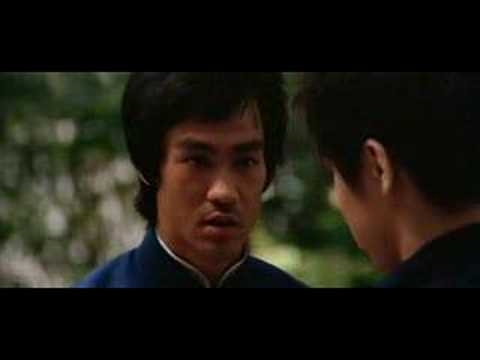
Por isso , em cenas como essa acima do filme "Operação Dragão"(Enter the Dragon,1973) , na qual Bruce Lee diz a seu aluno que nunca tire os olhos do oponente, mesmo quando o cumprimentá-lo abaixando a cabeça não faz sentido. É como se você demonstrasse confiança desconfiando.
So in scenes like the one above from the movie "Enter the Dragon" (1973), in which Bruce Lee tells his student that he never must take his eyes off the opponent, even when greeting him lowering his head does not make sense . It's like you showed confidence with suspicious.
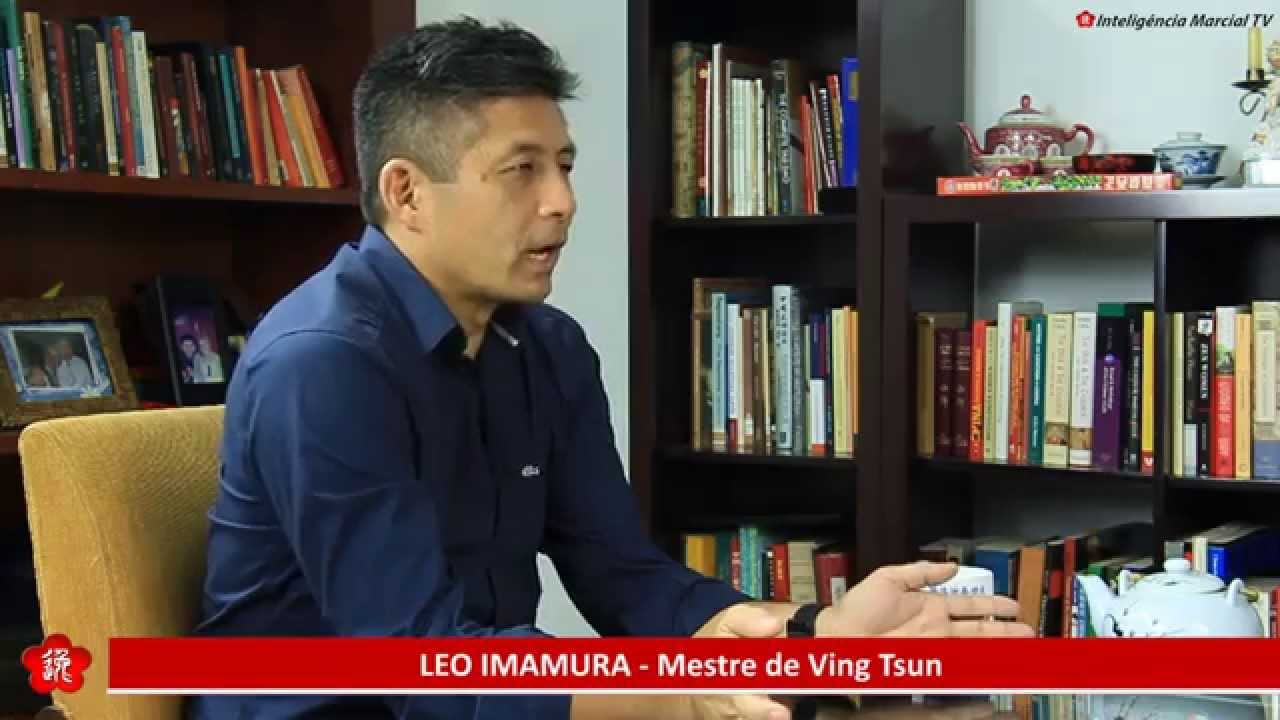
(Grão-Mestre Moy Yat e Mestre Leo Imamura praticando o Chi Sau)
(Grand-Master Moy Yat and Master Leo Imamura practicing Chi Sau)
"Dui Ying (對形)" geralmente é traduzido como "Ficar de frente" . "Dui "(對) pode ser traduzido como "Encarar" e "Ying" (形) significa também "Formato". Como se você encarasse um vulto.
Para o praticante de Ving Tsun Kung Fu, se torna essencial , com a prática do Siu Nim Tau, o Primeiro Domínio do Sistema, descobrir como elencar suas prioridades, a fim de saber para onde deve estar seu "Dui Ying (對形)". Pois enquanto isso não estiver claro, na vida em que os adversários não estão bem definidos ou muitas vezes nem possuem forma. Podemos não estar com todas as nossas ferramentas disponíveis, pois não entendemos como estar de frente para o que é importante.
"Dui Ying (對 形)" is usually translated as "Being in front." "Dui" (對) can be translated as "Facing" and "Ying" (形) also means "Shape". .
For the practitioner of Ving Tsun(Wing Chun) Kung Fu, it becomes essential to the practice of Siu Nim Tau, the First Domain of the System, find out how to list your priorities in order to know where your "Dui Ying (對 形)" should pointed to. Because while it is unclear in life when the opponents are not well defined or often do not have shapes. We can not be with all of our tools available, we do not understand how to be facing what is important.
A prática do "Muk Yan Jong"(木人樁), o "Boneco de Madeira", tão presente nos filmes de "O Grande Mestre". Por muitas vezes foi, e infelizmente ainda é, interpretado como uma ferramenta para "calejar os braços". Mas veja, quando "Dui Ying (對形)" é mais uma vez aprofundado em sua tradução, "Dui"(對) pode ser entendido como "ajustar" e "Ying" (形) pode significar "aparecer". Então teríamos "se ajustar ao que aparece".
The practice of "Muk Yan Jong" (木人 樁), the "Wooden Dummy", so present in the "Ip Man" movies. By often it was, and unfortunately still is, seen as a tool for make your arms stronger. But look, when "Dui Ying (對 形)" is deeper studied in its translation, "Dui" (對) can be understood as "Adjust" and "Ying" (形) can mean "to appear". Then we would "Adjust to what appears".
Por isso que quando circundamos o "Muk Yan Jong"(木人樁), nosso "Dui Ying (對形)" precisa se ajustar a essa face dele que estava lá nos esperando antes que movessemos. Por isso, que entender o "Muk Yan Jong"(木人樁) como uma ferramenta para o Kung Fu é algo primordial. Mas você também pode ficar batendo nele se quiser..rs Eu não vou segurá-lo..rs
So, when we go around the 'Muk Yan Jong "(木人 樁), our Dui Ying (對 形) needs to adjust to its face that it was there waiting for us before we move. Therefore, to understand the 'Muk Yan Jong "(木人 樁) as a tool for Kung Fu is something primordial. But you can also stay beating it up If you wanna..rs I will not hold you ..lol
(Eu e Si Fu)
(Si Fu and I)
Porém, mais importante do que tudo que foi traduzido, é entender , como diz Si Gung, que um discípulo de um Si Fu, não precisa ir buscar nos dicionários os significados dos termos. Ele terá em seu Si Fu, o significado que é acolhido em sua Família, bem como, a pronúncia de um ideograma.. Isso , apesar de parecer pouco para um olhar qualquer, também identifica esse discípulo, como membro de sua Família Kung Fu. Pois ele abraçou o jeito do seu Si Fu(foto)
But more important than all that has been translated, it is to understand, as you Si Gung says,that a disciple of a Si Fu, do not have to look for the meanings in the dictionary . He will take from his Si Fu, the meaning wich is welcomed in his family as well as the pronunciation of an ideogram .. This, though it seems a little detail , one will also be identified as a disciple, as a member of his Kung Fu Family. Because he embraces the way of his Si Fu (photo)
A disciple of Master Julio Camacho
Thiago Pereira "Moy Fat Lei"
moyfatlei.myvt@gmail.com
segunda-feira, 14 de setembro de 2015
(HOW TO WRITE THE KUNG FU TERMS IN A CORRECT WAY)O SISTEMA MOY YAT VING TSUN DE TRANSLITERAÇÃO
A minha querida professora (foto)de mandarim ,Sra. Lily Ou Yee Fen,é uma pioneira no ensino desse idioma em nossa cidade. Tendo sido professora de toda uma geração de entusiastas e estudiosos do idioma chinês durante três décadas , incluindo meu próprio Si Fu.
Ela me disse no meu primeiro dia de aula de com ela , que a China conta com 56 etnias reconhecidas pelo governo. Cada uma delas, possui seu próprio dialeto.
Eu fiquei muito impressionado com essa informação, pois imediatamente me veio à cabeça a cena do filme "Herói"(Hero,2002).
My beloved chinese teacher (photo) , Ms. Lily Ou Yee Fen, is a pioneer in the teaching of this language in Rio de Janeiro. Having been a teacher of a whole generation of enthusiasts and students of the Chinese language for three decades, including my own Si Fu.
She told me on my first day of class with her, that China has 56 ethnic groups recognized by the government. Each of them has its own dialect.
I was very impressed with this information, as immediately came to my mind a scene from the movie Hero(2002).
Na cena em questão o personagem "Sem-nome"(Jet Li), diz ao imperador que havia requisitado do personagem "Espada Quebrada"(Tony Leung) , que além de artista marcial era calígrafo(foto), que fizesse para ele uma variação além das dezesseis possibilidades existentes de se passar a ideia de "espada" com um ideograma.
"Absurdo!" - Disse o imperador. - "Como as pessoas podem se comunicar num país em que existem tantas formas diferentes de escrever?" - Concluiu ele.
In the scene in question the character "Nameless" (Jet Li), tells the emperor that he had requested from the character "Broken Sword" (Tony Leung), who in addition to martial artist was calligrapher (photo), to make for him a variation apart from sixteen possibilities to give the idea of "sword" with an ideogram.
"Nonsense!" - Said the emperor. - "How can people communicate in a country where there are so many different ways to write?" - He concluded.
Foi por isso que o governo chinês estabeleceu que o "Dialeto Han" (Hànyǔ汉语), dialeto falado pela etnia que corresponde a 95% da população chinesa, os "Han"(汉), se tornaria o idioma oficial em toda a China.
Porém, o chamado "cantonês" (Guàntánghuà 觀塘话) é muito utilizado até os dias de hoje no sul da China e em Hong Kong. Apesar do "Dialeto Han" , que conhecemos como "Mandarim", ser o idioma oficial.
O Governo Chinês na segunda metade do século 20, pediu , segundo Si Gung(foto), as agências de notícias chinesas e de todo o mundo, que adotasse o método "Pin Yin" (pīnyīn 拼音) como a forma oficial de transliterar os sons que os ideogramas fazem. Ou seja, uma forma de os ocidentais conseguirem "ler os sons" que os caracteres representam.
That's why the Chinese government has established the "dialect Han" (Hànyǔ 汉语) dialect spoken by the ethnic group corresponding to 95% of the Chinese population, "Han" (汉), would become the official language throughout China.
However, the so-called "Cantonese" (Guàntánghuà 觀塘 话) is widely used to this day in southern China and Hong Kong. Despite the "Han dialect," we know as "Mandarin", is the official language.
The Chinese government in the second half of the 20th century, called, according to Si Gung (photo), Chinese news agencies and from around the world, to adopt the "Pin Yin" method (pīnyīn 拼音) as the official way to transliterate the sounds that the ideograms do. That is, one way to achieve Western "read sounds" that the character represents.
Curioso dizer que Donnie Yen nos filmes do "Grande Mestre"(foto) , não usa a mesma fala que o Patriarca Ip Man usava. Já que Ip Man era originário de Faat Saan (Fo Shan) ele usava o dialeto dessa região, enquanto que em Hong Kong o dialeto usado é o Cantonês.
Diferente do mandarim e seu sistema "Pin Yin" de transliteração oficial , o cantonês não possui um sistema de transliteração. E por conta disso, o nome de nossa arte tem tantas variações: Wing Chun, Ving Tsun, Wing Tsun, etc...
Curious to say that Donnie Yen in the "Ip Man" movies(photo), does not use the same speech that the Patriarch Ip Man wore. Since Ip Man was from Faat Saan (Fo Shan) he used the dialect of the region, while in Hong Kong the used dialect is HK Cantonese.
Different from Mandarin and your "Pin Yin" system the official transliteration, Cantonese has no transliteration system. And because of that, the name of our art has so many variations: Wing Chun, Ving Tsun, Wing Tsun, etc ...
Segundo Si Gung, Si Taai Gung Moy Yat que é de um vilarejo chamado Duen Fan em GwongTong que tem um dialeto peculiar a região. Ou seja, temos Grão-Mestre Moy Yat que tinha sua fala oriunda de sua terra natal, recebendo seus ensinamentos em Hong Kong, de Ip Man que falava o "Faatsanês"...
According to Si Gung, Si Taai Gung Moy Yat who is from a village called Duen Fan in GwongTong which has a peculiar dialect of the region. Ie we have Grand Master Moy Yat who had his way of talk coming from his homeland, receiving his teaching in Hong Kong,by Ip Man who spoke a "Faat San-nese" ("Fo Shan -nese") ...
Por isso, em conversa recente com Si Gung (foto) , os Si Baak: Renato e Natan, os Si Suk: Mirta(Argentina) , Cris e Paul. E o Si Dai Thiago Silva. Pude mais uma vez admirar a sagacidade de Si Taai Gung Moy Yat, quando Si Gung falava das diferentes formas de se falar , inclusive uma mesma língua como o português e suas nuances. Ele citou como exemplo, o fato de que alguns membros da Argentina de nosso Clã tem dificuldade em entender o português do Rio, que é mais puxado como o de Portugal , tendo em vista que nosso estado foi a Capital de nosso país por muito tempo.
A isso, ele citou o fato de que muitos se referem a Leung Bok To, marido de nossa fundadora , como "Leung Bok Chao". Si Gung disse que não está incorreto pois essa é uma pronúncia possível para este nome , porém, na época em que esse ancestral viveu, a pronúncia de seu nome era "Leung Bok To" e não "Chao". E sabemos disso hoje, graças ao legado de Si Taai Gung Moy Yat.
So, in a recent conversation with Si Gung (photo), the Si Baak: Renato and Natan, the Si Suk: Mirta (Argentina), Cris and Paul. And my Si Dai Thiago Silva. I could once again admire the wisdom of Si Taai Gung Moy Yat, when Si Gung spoke of different ways to talk about, including the same language as the Portuguese and their nuances. He cited as an example the fact that some members of the Argentina of our clan has difficulty in understanding the Portuguese from Rio, which is pulled over like that from Portugal, given that our state was the Capital of our country for a long time.
To this, he cited the fact that many refer to Leung Bok To the husband of our founder, as "Leung Bok Chao." Si Gung said he is not incorrect as this is a pronunciation possible for this name, however, by the time this ancestor lived, the pronunciation of his name was "Leung Bok To" and not "Chao". And we know it today, thanks to the legacy of Si Taai Gung Moy Yat.
Sidney Lau (chinês: 劉錫祥, morreu 1987) escreveu uma série de livros na década de 1970, para o ensino para se falar o Cantonês. Os livros foram inicialmente utilizados para o ensino de expatriados ocidentais que trabalhavam no Corpo de Polícia de Hong Kong e outros órgãos governamentais.Mais tarde, os textos foram usados como base para um programa de ensino de rádio para estrangeiros. Os livros introduziam um sistema próprio de romanização de Lau que difere do sistema de Yale usando símbolos e números sobrescritos para indicar os tons das palavras. O sistema é um dos três sistemas de romanização ainda em uso em Hong Kong (fonte : Wikipedia)
Sidney Lau (Chinese: 劉錫祥, died 1987) wrote a series of textbooks in the 1970s, for teaching Anglophones to speak Cantonese. The textbooks were initially used for teaching western expatriates working in the Hong Kong Police Force and other government bodies.[1] Later the texts were used as a basis for a radio teaching programme for foreigners. The books introduced Lau's own romanisation system which differs from the Yale system by using superscripted numbers and symbols to indicate the tones of the words. The system is one of three romanisation systems still in use in Hong Kong (font: Wikipedia)
A fim de ter uma unidade em sua transliteração, e um desejo de que os termos sejam minimamente respeitados com uma pronúncia aproximada. Si Gung adota o método de Sidney Lau de "romanização", ou seja, de trazer para o nosso alfabeto e por conseguinte, para nossa compreensão. Os sons que cada ideograma faça, de modo que consigamos lê-los e reproduzi-los oralmente.
In order to take a drive in its transliteration, and a wish that the terms are minimally respected with an approximate pronunciation. Si Gung adopts the method of Sidney Lau "Romanization", ie to bring our alphabet and therefore for our understanding. The sounds that each ideogram do, so we can read them and play them orally.

Importante dizer que o (Hànyǔ汉语), que nós chamamos de "Mandarim". Possui quatro tons e um tom neutro (que muitos consideram um quinto tom). Por "tom" entenda a pronúncia de um som , neste caso, de 5 formas diferentes. Ou seja, uma pronúncia alongada ou mais curta, pode resultar num significado completamente diferente.
Pensando nisso, o método de Sidney Lau foi adotado, pois ele não se baseia nos diferentes tons do dialeto cantonês como o Sistema Yale. E sua transliteração não é baseada no português apenas, mas em fonemas que deixam mais próximo do original.
Importantly to say that, the (Hànyǔ 汉语), which we call "Mandarin". It has four tones and a neutral (which many consider a fifth tone). By "tone" is meant the pronunciation of a sound in this case, 5 of different shapes. That is, an elongated pronunciation or more short may result in a completely different meaning.
With this in mind, the method of Sidney Lau was adopted because it is not based on different tones of Cantonese dialect as the Yale System. And its transliteration is not based in Portuguese only, but phonemes that make closer to the original.
Por volta de 2009, Si Gung me sugeriu usar a transliteração corrente em nosso Clã , baseada no Sistema de Sidney Lau no "Blog do Pereira", de forma a sutilmente, educar as pessoas para uma transliteração que contemplasse a pronúncia dos termos e nomes dos ancestrais.
Por isso, o "Chum Kiu" foi sempre escrito aqui como "Cham Kiu". Pela primeira vez na internet também passamos a dividir a nomeclatura de tratamento como "SiFu" para "Si Fu". Ou "Sihing" para "Si Hing". Mas principalmente "Sijeh" para "Si Je" ou "Gerk" para "Geuk".
By 2009, Si Gung suggested I use the current transliteration in our clan, based in Sidney Lau System in "The Peartree's Blog(Blog do Pereira)" in order to subtly educate people to a transliteration contemplating the pronunciation of terms and names of the ancestors.
Therefore, the "Chum Kiu" is always written here as "Cham Kiuh". For the first time on the internet also passed to divide the naming treatment as "SiFu" to "Si Fu". Or "Sihing" to "Si Hing." But mostly "Sijeh" to "Si Je" or "Gerk" to "Geuk".
Ainda temos muito o que falar sobre este tema. Mas humildemente me coloco disponível para compartilhar mais , seja por email (moyfatlei.myvT@Gmail.com) ou por skype (moyfatlei.myvt) , sobre este tema com aqueles que se interessarem.
We still have much to say on this topic. But humbly I place myself available to share more, either by email (moyfatlei.myvT@Gmail.com) or skype (moyfatlei.myvt) on this subject with those who are interested.
A disciple of Master Julio Camacho
Thiago Pereira "Moy Fat Lei"
moyfatlei.myvt@gmail.com
Ela me disse no meu primeiro dia de aula de com ela , que a China conta com 56 etnias reconhecidas pelo governo. Cada uma delas, possui seu próprio dialeto.
Eu fiquei muito impressionado com essa informação, pois imediatamente me veio à cabeça a cena do filme "Herói"(Hero,2002).
My beloved chinese teacher (photo) , Ms. Lily Ou Yee Fen, is a pioneer in the teaching of this language in Rio de Janeiro. Having been a teacher of a whole generation of enthusiasts and students of the Chinese language for three decades, including my own Si Fu.
She told me on my first day of class with her, that China has 56 ethnic groups recognized by the government. Each of them has its own dialect.
I was very impressed with this information, as immediately came to my mind a scene from the movie Hero(2002).
Na cena em questão o personagem "Sem-nome"(Jet Li), diz ao imperador que havia requisitado do personagem "Espada Quebrada"(Tony Leung) , que além de artista marcial era calígrafo(foto), que fizesse para ele uma variação além das dezesseis possibilidades existentes de se passar a ideia de "espada" com um ideograma.
"Absurdo!" - Disse o imperador. - "Como as pessoas podem se comunicar num país em que existem tantas formas diferentes de escrever?" - Concluiu ele.
In the scene in question the character "Nameless" (Jet Li), tells the emperor that he had requested from the character "Broken Sword" (Tony Leung), who in addition to martial artist was calligrapher (photo), to make for him a variation apart from sixteen possibilities to give the idea of "sword" with an ideogram.
"Nonsense!" - Said the emperor. - "How can people communicate in a country where there are so many different ways to write?" - He concluded.
Porém, o chamado "cantonês" (Guàntánghuà 觀塘话) é muito utilizado até os dias de hoje no sul da China e em Hong Kong. Apesar do "Dialeto Han" , que conhecemos como "Mandarim", ser o idioma oficial.
O Governo Chinês na segunda metade do século 20, pediu , segundo Si Gung(foto), as agências de notícias chinesas e de todo o mundo, que adotasse o método "Pin Yin" (pīnyīn 拼音) como a forma oficial de transliterar os sons que os ideogramas fazem. Ou seja, uma forma de os ocidentais conseguirem "ler os sons" que os caracteres representam.
That's why the Chinese government has established the "dialect Han" (Hànyǔ 汉语) dialect spoken by the ethnic group corresponding to 95% of the Chinese population, "Han" (汉), would become the official language throughout China.
However, the so-called "Cantonese" (Guàntánghuà 觀塘 话) is widely used to this day in southern China and Hong Kong. Despite the "Han dialect," we know as "Mandarin", is the official language.
The Chinese government in the second half of the 20th century, called, according to Si Gung (photo), Chinese news agencies and from around the world, to adopt the "Pin Yin" method (pīnyīn 拼音) as the official way to transliterate the sounds that the ideograms do. That is, one way to achieve Western "read sounds" that the character represents.
Curioso dizer que Donnie Yen nos filmes do "Grande Mestre"(foto) , não usa a mesma fala que o Patriarca Ip Man usava. Já que Ip Man era originário de Faat Saan (Fo Shan) ele usava o dialeto dessa região, enquanto que em Hong Kong o dialeto usado é o Cantonês.
Diferente do mandarim e seu sistema "Pin Yin" de transliteração oficial , o cantonês não possui um sistema de transliteração. E por conta disso, o nome de nossa arte tem tantas variações: Wing Chun, Ving Tsun, Wing Tsun, etc...
Curious to say that Donnie Yen in the "Ip Man" movies(photo), does not use the same speech that the Patriarch Ip Man wore. Since Ip Man was from Faat Saan (Fo Shan) he used the dialect of the region, while in Hong Kong the used dialect is HK Cantonese.
Different from Mandarin and your "Pin Yin" system the official transliteration, Cantonese has no transliteration system. And because of that, the name of our art has so many variations: Wing Chun, Ving Tsun, Wing Tsun, etc ...
Segundo Si Gung, Si Taai Gung Moy Yat que é de um vilarejo chamado Duen Fan em GwongTong que tem um dialeto peculiar a região. Ou seja, temos Grão-Mestre Moy Yat que tinha sua fala oriunda de sua terra natal, recebendo seus ensinamentos em Hong Kong, de Ip Man que falava o "Faatsanês"...
According to Si Gung, Si Taai Gung Moy Yat who is from a village called Duen Fan in GwongTong which has a peculiar dialect of the region. Ie we have Grand Master Moy Yat who had his way of talk coming from his homeland, receiving his teaching in Hong Kong,by Ip Man who spoke a "Faat San-nese" ("Fo Shan -nese") ...
Pronunciando o nome dos Ancestrais do Ving Tsun:
Pronouncing the name of the Ancestors of Ving Tsun:
Por isso, em conversa recente com Si Gung (foto) , os Si Baak: Renato e Natan, os Si Suk: Mirta(Argentina) , Cris e Paul. E o Si Dai Thiago Silva. Pude mais uma vez admirar a sagacidade de Si Taai Gung Moy Yat, quando Si Gung falava das diferentes formas de se falar , inclusive uma mesma língua como o português e suas nuances. Ele citou como exemplo, o fato de que alguns membros da Argentina de nosso Clã tem dificuldade em entender o português do Rio, que é mais puxado como o de Portugal , tendo em vista que nosso estado foi a Capital de nosso país por muito tempo.
A isso, ele citou o fato de que muitos se referem a Leung Bok To, marido de nossa fundadora , como "Leung Bok Chao". Si Gung disse que não está incorreto pois essa é uma pronúncia possível para este nome , porém, na época em que esse ancestral viveu, a pronúncia de seu nome era "Leung Bok To" e não "Chao". E sabemos disso hoje, graças ao legado de Si Taai Gung Moy Yat.
So, in a recent conversation with Si Gung (photo), the Si Baak: Renato and Natan, the Si Suk: Mirta (Argentina), Cris and Paul. And my Si Dai Thiago Silva. I could once again admire the wisdom of Si Taai Gung Moy Yat, when Si Gung spoke of different ways to talk about, including the same language as the Portuguese and their nuances. He cited as an example the fact that some members of the Argentina of our clan has difficulty in understanding the Portuguese from Rio, which is pulled over like that from Portugal, given that our state was the Capital of our country for a long time.
To this, he cited the fact that many refer to Leung Bok To the husband of our founder, as "Leung Bok Chao." Si Gung said he is not incorrect as this is a pronunciation possible for this name, however, by the time this ancestor lived, the pronunciation of his name was "Leung Bok To" and not "Chao". And we know it today, thanks to the legacy of Si Taai Gung Moy Yat.
O Sistema Moy Yat Ving Tsun de Transliteração:
The Moy Yat Ving Tsun Transliteration system :
Sidney Lau (chinês: 劉錫祥, morreu 1987) escreveu uma série de livros na década de 1970, para o ensino para se falar o Cantonês. Os livros foram inicialmente utilizados para o ensino de expatriados ocidentais que trabalhavam no Corpo de Polícia de Hong Kong e outros órgãos governamentais.Mais tarde, os textos foram usados como base para um programa de ensino de rádio para estrangeiros. Os livros introduziam um sistema próprio de romanização de Lau que difere do sistema de Yale usando símbolos e números sobrescritos para indicar os tons das palavras. O sistema é um dos três sistemas de romanização ainda em uso em Hong Kong (fonte : Wikipedia)
Sidney Lau (Chinese: 劉錫祥, died 1987) wrote a series of textbooks in the 1970s, for teaching Anglophones to speak Cantonese. The textbooks were initially used for teaching western expatriates working in the Hong Kong Police Force and other government bodies.[1] Later the texts were used as a basis for a radio teaching programme for foreigners. The books introduced Lau's own romanisation system which differs from the Yale system by using superscripted numbers and symbols to indicate the tones of the words. The system is one of three romanisation systems still in use in Hong Kong (font: Wikipedia)
A fim de ter uma unidade em sua transliteração, e um desejo de que os termos sejam minimamente respeitados com uma pronúncia aproximada. Si Gung adota o método de Sidney Lau de "romanização", ou seja, de trazer para o nosso alfabeto e por conseguinte, para nossa compreensão. Os sons que cada ideograma faça, de modo que consigamos lê-los e reproduzi-los oralmente.
In order to take a drive in its transliteration, and a wish that the terms are minimally respected with an approximate pronunciation. Si Gung adopts the method of Sidney Lau "Romanization", ie to bring our alphabet and therefore for our understanding. The sounds that each ideogram do, so we can read them and play them orally.
Importante dizer que o (Hànyǔ汉语), que nós chamamos de "Mandarim". Possui quatro tons e um tom neutro (que muitos consideram um quinto tom). Por "tom" entenda a pronúncia de um som , neste caso, de 5 formas diferentes. Ou seja, uma pronúncia alongada ou mais curta, pode resultar num significado completamente diferente.
Pensando nisso, o método de Sidney Lau foi adotado, pois ele não se baseia nos diferentes tons do dialeto cantonês como o Sistema Yale. E sua transliteração não é baseada no português apenas, mas em fonemas que deixam mais próximo do original.
Importantly to say that, the (Hànyǔ 汉语), which we call "Mandarin". It has four tones and a neutral (which many consider a fifth tone). By "tone" is meant the pronunciation of a sound in this case, 5 of different shapes. That is, an elongated pronunciation or more short may result in a completely different meaning.
With this in mind, the method of Sidney Lau was adopted because it is not based on different tones of Cantonese dialect as the Yale System. And its transliteration is not based in Portuguese only, but phonemes that make closer to the original.
Por volta de 2009, Si Gung me sugeriu usar a transliteração corrente em nosso Clã , baseada no Sistema de Sidney Lau no "Blog do Pereira", de forma a sutilmente, educar as pessoas para uma transliteração que contemplasse a pronúncia dos termos e nomes dos ancestrais.
Por isso, o "Chum Kiu" foi sempre escrito aqui como "Cham Kiu". Pela primeira vez na internet também passamos a dividir a nomeclatura de tratamento como "SiFu" para "Si Fu". Ou "Sihing" para "Si Hing". Mas principalmente "Sijeh" para "Si Je" ou "Gerk" para "Geuk".
By 2009, Si Gung suggested I use the current transliteration in our clan, based in Sidney Lau System in "The Peartree's Blog(Blog do Pereira)" in order to subtly educate people to a transliteration contemplating the pronunciation of terms and names of the ancestors.
Therefore, the "Chum Kiu" is always written here as "Cham Kiuh". For the first time on the internet also passed to divide the naming treatment as "SiFu" to "Si Fu". Or "Sihing" to "Si Hing." But mostly "Sijeh" to "Si Je" or "Gerk" to "Geuk".
Ainda temos muito o que falar sobre este tema. Mas humildemente me coloco disponível para compartilhar mais , seja por email (moyfatlei.myvT@Gmail.com) ou por skype (moyfatlei.myvt) , sobre este tema com aqueles que se interessarem.
We still have much to say on this topic. But humbly I place myself available to share more, either by email (moyfatlei.myvT@Gmail.com) or skype (moyfatlei.myvt) on this subject with those who are interested.
A disciple of Master Julio Camacho
Thiago Pereira "Moy Fat Lei"
moyfatlei.myvt@gmail.com
Marcadores:
barra,
cantones,
centro,
copacabana,
jacarepagua,
kung fu,
mandarim,
mandarin,
meier,
méier,
SIDNEY LAU,
tijuca,
transliteração,
ving tsun,
wing chun
quarta-feira, 9 de setembro de 2015
KUNG FU CULTURE SEASON 2 TRAILER
Chegou a hora da segunda temporada de "Cultura Kung Fu"!
It's time for "Kung Fu Culture" Season 2!
terça-feira, 8 de setembro de 2015
(IP MAN 3 NEXT CHRISTMAS!)"O GRANDE MESTRE 3" COM DATA DE ESTRÉIA!
Aqueles que gostam de saber de tudo antes podem agora ter uma prévia com as fotos oficiais do filme "O Grande Mestre 3" divulgadas hoje!
Mike Tyson, Zhang Jin e Donnie Yen mostram as suas melhores poses de luta .
"O Grande Mestre 3" vem sendo anunciado como a última palavra em coreografias de lutas. Seja de Kung Fu ou de boxe. Os produtores prometem algo nunca antes visto!
O filme continua a cinebiografia de mestre do patriarca do Ving Tsun (Wing Chun) Ip Man, desta vez, com seu discípulo Bruce Lee, e seu fatídico encontro com um americano boxeador..
font: Donnie Yen social media
Anticipators may now have a mini visual feast, with the preview movie stills of Ip Man 3 released today!
Mike Tyson, Zhang Jin and Donnie Yen show off their best fight poses, and tease viewers with photos taken on the set itself. With less than three months to its opening, Ip Man 3 has been hyped as THE ultimate, never-seen-before showdown between Chinese kung fu and Western heavyweight fight techniques.
The film continues the biopic of Wing Chun master Ip Man, his newly-initiated disciple Bruce Lee, and his fateful encounter with an American property agent.
Sr. Ip Chun, o filho mais velho do Patriarca Ip Man, também comemorou seu 91º aniversário na semana passada. O ator Zhang Jin(foto de pé a direita), que estará em "O Grande Mestre 3" estava na celebração para receber suas bênçãos e felicitá-lo, enquanto Donnie Yen, que estava no exterior, filmou um vídeo curto para estender seus desejos.
Mr Ip Chun, the eldest son of Master Yip Man, had also celebrated his 91st birthday last week. The fresh-faced Zhang Jin was at his celebration to receive his blessings and congratulate him, while Donnie Yen, who was abroad, filmed a short video to extend his wishes.
Ip Man 3 terá sua estréia em Cingapura no dia 31 de Dezembro de 2015, com teasers na véspera de Natal, 24 de dezembro de 2015.
Ip Man 3 opens in Singapore on the 31st of December 2015, with sneaks this Christmas Eve, 24th of December 2015.
(Mike Tyson socando o ar)
(Mike Tyson doing his thing)
Donnie Yen em suas redes sociais também prometeu um trailer para o final de Setembro! Agora é aguardar pela luta usando as facas e entender o que Mike Tyson faz nesse filme!
Donnie Yen in hissocial networks also promised a trailer for the end of September! Now is wait for the fight using knives and understand what Mike Tyson is doing in this movie!
Mike Tyson, Zhang Jin e Donnie Yen mostram as suas melhores poses de luta .
"O Grande Mestre 3" vem sendo anunciado como a última palavra em coreografias de lutas. Seja de Kung Fu ou de boxe. Os produtores prometem algo nunca antes visto!
O filme continua a cinebiografia de mestre do patriarca do Ving Tsun (Wing Chun) Ip Man, desta vez, com seu discípulo Bruce Lee, e seu fatídico encontro com um americano boxeador..
font: Donnie Yen social media
Anticipators may now have a mini visual feast, with the preview movie stills of Ip Man 3 released today!
Mike Tyson, Zhang Jin and Donnie Yen show off their best fight poses, and tease viewers with photos taken on the set itself. With less than three months to its opening, Ip Man 3 has been hyped as THE ultimate, never-seen-before showdown between Chinese kung fu and Western heavyweight fight techniques.
The film continues the biopic of Wing Chun master Ip Man, his newly-initiated disciple Bruce Lee, and his fateful encounter with an American property agent.
Sr. Ip Chun, o filho mais velho do Patriarca Ip Man, também comemorou seu 91º aniversário na semana passada. O ator Zhang Jin(foto de pé a direita), que estará em "O Grande Mestre 3" estava na celebração para receber suas bênçãos e felicitá-lo, enquanto Donnie Yen, que estava no exterior, filmou um vídeo curto para estender seus desejos.
Mr Ip Chun, the eldest son of Master Yip Man, had also celebrated his 91st birthday last week. The fresh-faced Zhang Jin was at his celebration to receive his blessings and congratulate him, while Donnie Yen, who was abroad, filmed a short video to extend his wishes.
( Zhang Jin e Donnie Yen praticam algo parecido com Chi Sau)
(Zhang Jin and Donnie Yen doing something alike Chi Sau)
Ip Man 3 terá sua estréia em Cingapura no dia 31 de Dezembro de 2015, com teasers na véspera de Natal, 24 de dezembro de 2015.
Ip Man 3 opens in Singapore on the 31st of December 2015, with sneaks this Christmas Eve, 24th of December 2015.
(Mike Tyson socando o ar)
(Mike Tyson doing his thing)
Donnie Yen em suas redes sociais também prometeu um trailer para o final de Setembro! Agora é aguardar pela luta usando as facas e entender o que Mike Tyson faz nesse filme!
Donnie Yen in hissocial networks also promised a trailer for the end of September! Now is wait for the fight using knives and understand what Mike Tyson is doing in this movie!
Marcadores:
donnie yen,
donnie yen e mike tyson,
ip man 3,
kung fu,
meier,
méier,
moy yat,
moyat,
o grande mestre 3,
tijuca,
ving tsun,
wing chun,
Zhang Jin
segunda-feira, 7 de setembro de 2015
THE VING TSUN KICKS - Kung Fu Culture S01E14 (Leg -PTBr)
O programa "Kung Fu Culture" em sua segunda temporada retorna no próximo dia 11. Até lá, vamos relembrar o episódio 14 da primeira temporada sobre "Chutes no Ving Tsun"
The "Kung Fu Culture" show comes back next Friday.11 . Untill there, lets remember the episode 14 about kicks in Ving Tsun (Wing Chun).
A disciple of Master Julio Camacho
(11Generation Ving Tsun) Senior Master
Thiago Pereira "Moy Fat Lei"
(12G VT) Qualified Master
moyfatlei.myvt@gmail.com
The "Kung Fu Culture" show comes back next Friday.11 . Untill there, lets remember the episode 14 about kicks in Ving Tsun (Wing Chun).
A disciple of Master Julio Camacho
(11Generation Ving Tsun) Senior Master
Thiago Pereira "Moy Fat Lei"
(12G VT) Qualified Master
moyfatlei.myvt@gmail.com
Assinar:
Postagens (Atom)


+129.jpg)
.jpg)